
Posted on Leave a comment

The Garo Oath: When Words Had Weight (And What We’ve Done to Commitment)

Garo Oath Integrity Words — In Garo tradition, an oath carried consequence. What the Garo oath system teaches about integrity, commitment, and why words have lost their weight.

Garo Oath Integrity Words: What You Need to Know

For further research, see the Garo people of Meghalaya.

A British official in the late 18th century described witnessing a Garo oath-taking with an honesty that is remarkable for its time. “The awe and reverence with which the man swore,” he wrote, “forcibly struck me. My assistant could hardly write, so much was he affected.”

The Garo ceremony of oath-taking was this: the person raised their hands to heaven, bowed their head to a stone, and looked steadfastly toward the hills while giving their evidence. Some placed a tiger’s bone between their teeth. Others grasped their weapons. A few took a handful of earth.

The hills were the witnesses. The stone was the witness. The earth in your hand was the witness. The oath was not addressed to a court or a contract or a counterparty — it was addressed to the landscape itself, which could not be bribed, which had no interest in the outcome, which would simply continue to exist after you were gone and your word was either kept or not.

Modern commitment has been productised. Terms and Conditions. End User License Agreements. Non-Disclosure Agreements. Contracts that require a solicitor to interpret and a decade to enforce. We have added so many layers of legal architecture to the problem of trust that the original thing — one person’s word given to another — has been almost entirely replaced by its documentation.

The Garo oath worked partly because breaking it carried consequences that could not be negotiated away. If you looked at the hills and lied, the hills knew. This is not literally true. But the Garo system of consequences was social rather than legal — it operated through reputation, through the knowledge that the village would remember, through the understanding that the hills had witnessed what you said.

We have traded this for systems that can be gamed more precisely and with better documentation. We have not obviously come out ahead.

There is a version of daily life that takes its small commitments as seriously as the Garo took theirs — that speaks as if the hills are listening, because something is always listening. It is not a popular discipline. But it makes the words you say mean something, which is the beginning of everything that is actually good.

Posted on Leave a comment

What the Garo Hills Know About Hospitality That Your Favourite Café Doesn’t

Garo Hospitality Gift Culture Tea — Garo hospitality is built on the gift — tea offered without transaction. What this cultural practice teaches about welcome, generosity, and what cafés have got wrong.

Garo Hospitality Gift Culture Tea: What You Need to Know

For further research, see the Garo people of Meghalaya.

There is a scene in the 1898 accounts of a journey through the Garo hills: a researcher stops at a village in the hills, admires a woman’s simpak cloth — a bark-cloth blanket drying on the roof. The woman, without hesitation, pulls it off the thatch and presents it. With a smile.

He hadn’t asked. She didn’t haggle. The offer was simply made because he had noticed it, and noticing a thing in a Garo context was understood as a kind of wanting, and wanting a thing that someone had was a social occasion for giving. The exchange was not transactional. It was relational. She gave; he was now in a relationship with her that carried its own obligations, which would play out through the social fabric of the village in ways he didn’t fully understand.

The Garo concept of hospitality was built on this principle: the gift precedes the request. You offer before you are asked. The feast is prepared before the guests arrive. The chu is poured before the news is shared. The social contract begins with generosity and works backward to need.

Modern hospitality — the café, the hotel, the concierge economy — begins with the menu. You tell us what you want; we provide it; you pay; the relationship ends. It is efficient and entirely pleasant and contains almost no human exchange whatsoever.

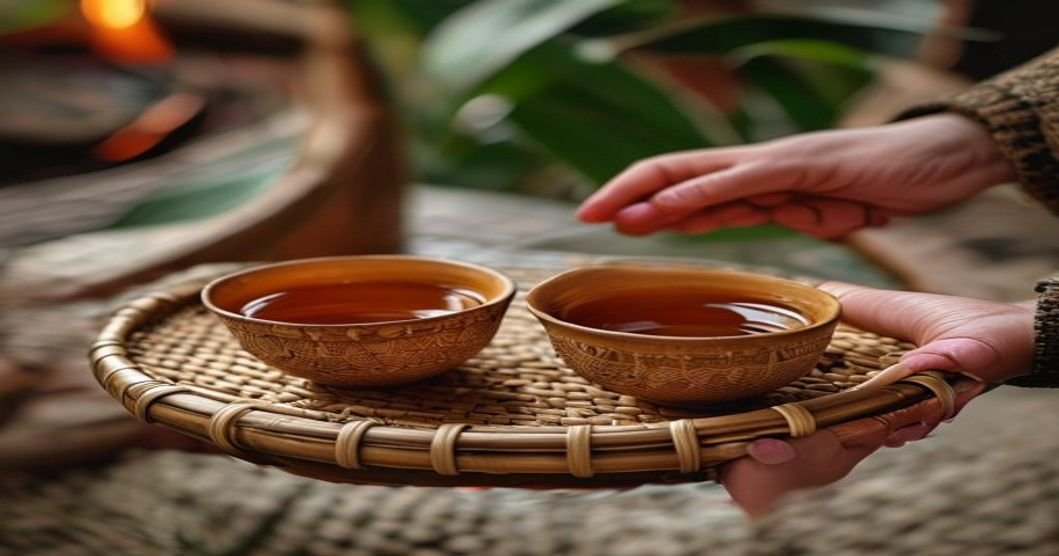
Tea sits at an interesting point in this. In most cultures that have a serious tea tradition, the offering of tea precedes everything — conversation, business, disclosure, need. You are given the cup before you are asked what you want. The cup is the statement that you are welcome, that your presence is noticed, that something is being made for you before you have explained yourself.

This is old. The Garo hills knew it. The Japanese tea ceremony knows it. The Bengali adda knows it. The Irish farmhouse cup-before-question knows it. The moment you give someone a cup of tea before they ask for it, you have done something small and genuinely human. It costs almost nothing. It is not nothing.

Posted on Leave a comment

Why the Garo Changed Their Names After a Tiger Attack (And What It Teaches About Reinvention)

Garo Name Change Tiger Identity — In Garo tradition, a person who survived a tiger attack changed their name — a complete reinvention of identity. What this teaches about transformation and starting again.

Garo Name Change Tiger Identity: What You Need to Know

For further research, see the Garo people of Meghalaya.

In the Garo hills, a name was considered to be, in some sense, an essential part of the person who carried it. Not just a label — an actual piece of you that could be found by anyone who knew it.

When a Garo person was attacked by a tiger and escaped, they changed their name. The logic was precise: the tiger now knew their name, and a tiger that knows your name can find you again. By becoming someone else — by taking a new name that the tiger did not know — the survivor placed themselves outside the reach of the thing that had almost killed them.

Even more remarkably: if a Garo was killed by a tiger, all of their relatives changed their names. The tiger might come back for the family. Better to present it with a set of strangers.

The modern self-help industry has built a substantial enterprise around the idea of reinvention. New habits. New identity. New morning routines. New self. Much of it is organised around the question: how do you become someone who does not repeat the patterns that have been damaging you?

The Garo answer is surprisingly specific: sometimes, you need to be someone the tiger doesn’t recognise. Not a better version of yourself — a genuinely different entity, with a different name, making different sounds, carrying different associations. The tiger hunts by familiarity. Make yourself unfamiliar.

This is not self-deception. The Garo person who changed their name after the tiger attack was the same person in every material sense. But they had declared, to themselves and to the village, that the chapter in which they were prey was over. The new name was the opening sentence of the next chapter.

There is a version of change that is purely internal — thoughts that shift, motivations that reconfigure. And there is a version that requires an external act: a name, a location, a commitment said out loud. The Garo system required the external act. The village witnessed it. The hills witnessed it. The tiger, somewhere in the jungle, was looking for someone who no longer existed.

The hills where this story lives are the same hills where our tea grows. Explore teas from West Garo Hills →

Posted on Leave a comment

The Forest That Belongs to Everyone: The Garo Commons and the Limits of Ownership

Forest Belongs Everyone Garo Commons — The Garo jhum system held abandoned clearings as village commons — they looked like virgin forest but were owned collectively, in time rather than space. An old answer to a very new problem.

Forest Belongs Everyone Garo Commons: What You Need to Know

Garo Commons — The Garo jhum system held abandoned clearings as village commons — they looked like virgin forest but were owned collectively, in time rather than space. An old answer to a very new problem.

Garo Commons: What You Need to Know

In the Garo jhum system, when a clearing was abandoned after two or three years of cultivation, it was given back to the jungle. Within a few seasons, it was indistinguishable from virgin forest — the trees returned, the undergrowth thickened, birds and animals came back, the topsoil rebuilt itself.

But the land was not forgotten. It still belonged to the village. It was held in the village’s common memory, recorded in social knowledge rather than paper title deeds: this section, resting now, will be available to clear in seven years. That section, dormant for twelve years, is ready when we need it.

The old site, which now looks like it has never been farmed, is the cause of frequent disputes, noted one observer — because everyone knew it was there, and because the knowledge of its availability was power. The commons was not unowned. It was owned differently: collectively, temporally, through memory rather than fences.

The tragedy of the commons — the economic theory that shared resources are inevitably overused and destroyed — assumes a particular kind of commons: one with no social enforcement, no memory, no governance. The Garo commons had all three. It was governed by the village’s collective knowledge of who had farmed where and when, enforced by social memory, and protected by the understanding that overusing your section now meant no section available later.

The Nokrek Biosphere Reserve — the UNESCO-designated world heritage site in the West Garo Hills — is there partly because the Garo people were custodians of its biodiversity for centuries before UNESCO existed. The wild citrus trees that grow in Nokrek, including Citrus indica, one of the wild ancestors of all cultivated citrus, are there because the Garo system of land use left space for them.

Tea grown in this region carries something of this relationship. Not grown on cleared, consolidated monoculture land. Grown on hillsides that still have the Garo hills‘ biodiversity in their soil memory. What the land remembers about rest and recovery ends up, in some small way, in the cup.

Posted on Leave a comment

The Garo Healer and the Supplement Industry: Two Approaches to Fixing What’s Wrong

Garo Healer Folk Medicine Wellness — The Garo healer worked with what the forest provided. The supplement industry works with what the market will bear. A comparison of two approaches to wellness.

Garo Healer Folk Medicine Wellness: What You Need to Know

For further research, see the Garo people of Meghalaya.

In the Garo hills, illness had two treatments. The first was the priest, who identified which demon was causing the problem and offered an appropriate sacrifice — a chicken, a goat, a set of rituals. If the chicken’s entrails fell apart cleanly, the demon had been appeased and recovery would follow.

The second was the old-country doctor. A few of these existed in each region, people who had acquired knowledge of specific plant preparations for specific ailments. Some of these preparations were, by all accounts, genuinely effective. One 19th-century observer noted that a village that had been severely affected by leprosy had, by the use of these remedies, become “quite free of it” — verified by multiple witnesses.

The modern wellness industry has inherited from both traditions. The supplement section of any health store is largely the priest’s tradition in new packaging: a product sold on the basis that your particular affliction (low energy, poor focus, suboptimal sleep) is caused by a specific deficiency that this specific product will address. The mechanism is different but the psychology is the same — identify the demon, sacrifice the money, receive the relief.

The genuine herbalist tradition — specific plant compounds with specific effects, built on accumulated empirical knowledge rather than theory — is the old-country doctor’s tradition. Green tea catechins actually do what the research says they do. Ginger actually has anti-inflammatory properties. The evidence is not the faith.

The West Garo Hills grows tea in a region where folk medicine and plant knowledge have been accumulating for centuries. The tea itself is not medicine. But it comes from land where the relationship between plants and human health has been taken seriously for a very long time. That’s not a health claim. It’s context. Context changes the flavour of things.