

Posted on Leave a comment

Bisi and Bijong: The Garo Story About the Friendship That Does Not Need a Reason

Bisi Bijong Garo Friendship Story — A Garo A'Chik folktale about Bisi and Bijong — two friends whose loyalty asks nothing in return. What the Garo know about the friendships that last.

Achik Tale Bisi Bijong Friends: What You Need to Know

Bisi Bijong Garo Friendship Story: What You Need to Know

Achik Tale Bisi Bijong Friends — A Garo A'Chik folktale about Bisi and Bijong — two friends whose loyalty asks nothing in return. What this story teaches about real connection.

For further research, see the Garo people of Meghalaya.

From A’Chik Golporang (Garo Folklore) Part III, Story 17 (Bisi-Bijong), collected by Dhoronsing K. Sangma.

In the third book of A’Chik Golporang, there is a story called Bisi-Bijong — two names held together without a connective, the way you hold two things that simply belong in each other’s company. The story is short. The friendship is the whole point.

Bisi and Bijong live in the Garo hills. They are not siblings. They are not related by the matrilineal clan system that governs Garo social structure. They chose each other. In a society where almost everything — property, marriage, social standing — is determined by which family you were born into, the freely chosen friendship was a notable act.

The story tracks them through a series of ordinary difficulties — a bad harvest season, a dispute with a neighbour, a period when one of them is ill and cannot tend the jhum. Through each, the friendship continues. Not heroically. Not with dramatic demonstrations. Bijong simply shows up at Bisi’s clearing. Bisi simply stays at Bijong’s changy an extra night.

The A’chik tradition does not romanticise this. The story does not end with a great sacrifice or a dramatic rescue. It ends with both of them old, sitting on the platform of Bijong’s borang, watching the valley below. Nothing required saving. Everything continued. This was the whole gift.

The A’chik proverb that closes the story: Ango tangka sona gri; indiba ango je gnang uko jatna on’a. — “What we carry as gold is heavy; but what stays without being asked — that is the actual thing.”


The gift of tea is a Bisi-Bijong gesture. Not the grand gesture. Not the thing that requires a reason. The thing that says: I was thinking of you, here is something that will make one morning yours.

It doesn’t need a birthday to justify it. It doesn’t need a relationship milestone. It just needs a person who would appreciate it and a moment when you thought of them.

The best friendships are like this too. No occasion required. Just: here. I thought of you.

The hills where this story lives are the same hills where our tea grows. Explore teas from West Garo Hills →

Posted on Leave a comment

The Borang: Why the Garo Built Their Beds in Trees (And What It Says About Rest)

Garo Borang Tree House Rest — The Garo borang — a tree platform for sleeping and watching — was designed for rest and perspective simultaneously. What this architectural choice teaches about recovery.

Garo Borang Tree House Rest: What You Need to Know

For further research, see the Garo people of Meghalaya.

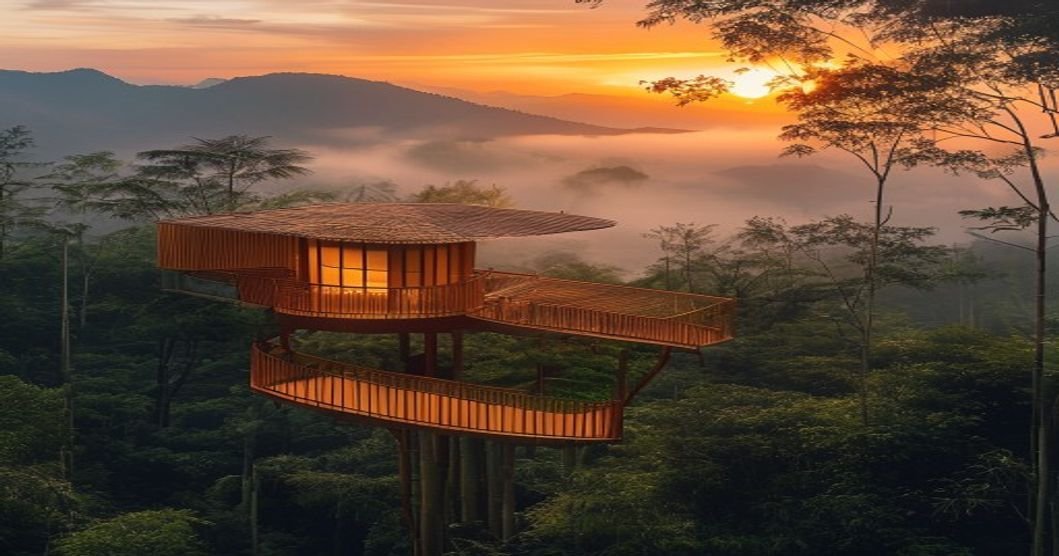
In the Garo hills, a traveller passing through the jungle would sometimes look up and see a house in a tree. Not a children’s platform — a real house. Forty feet off the ground, lashed to the branches with creeper ropes, floored with bamboo, inhabited by an entire family who cooked, ate, and slept up there.

The Garo borang (tree house) was practical: it gave purer air than the jungle floor, protection from mosquitoes, and a vantage point over the jhum fields to watch for birds and animals eating the crops. A mother who needed to descend had to navigate a bamboo ladder with her baby on her back, the rungs a wide stride apart.

But a missionary traveller who passed through in 1898 noted something beyond the practicality. He wrote that the Garos “seem to love a high roosting-place and have a bird’s fondness for being cradled by the wind.” The borang wasn’t just architecture. It was a preference.

Forty feet of elevation changes what you can see. From the ground, a forest is a wall. From the borang, it’s a canopy — you can see the ridgelines, the direction of weather, the clearing where the rice is growing, the river glinting a valley away. You are the same person with the same problems, but the problems are down there and you are up here, swaying slightly.

We have almost no equivalent in modern life. Our buildings keep us at ground level even when we’re twenty floors up, because the windows don’t open and the air conditioning is the same as the floor below. Our phones keep us at ground level because every notification is a pull back to the immediate, the reactive, the ground-floor urgency.

The borang mind is the one that steps slightly out of the ordinary stream — not to avoid the work, but to see it from above. To watch the crops rather than be in them. To feel the wind, which does not carry email.

A cup of tea in a quiet place is the closest most of us get to forty feet in a tree. Take it seriously.

Posted on Leave a comment

The Garo Oath: When Words Had Weight (And What We’ve Done to Commitment)

Garo Oath Integrity Words — In Garo tradition, an oath carried consequence. What the Garo oath system teaches about integrity, commitment, and why words have lost their weight.

Garo Oath Integrity Words: What You Need to Know

For further research, see the Garo people of Meghalaya.

A British official in the late 18th century described witnessing a Garo oath-taking with an honesty that is remarkable for its time. “The awe and reverence with which the man swore,” he wrote, “forcibly struck me. My assistant could hardly write, so much was he affected.”

The Garo ceremony of oath-taking was this: the person raised their hands to heaven, bowed their head to a stone, and looked steadfastly toward the hills while giving their evidence. Some placed a tiger’s bone between their teeth. Others grasped their weapons. A few took a handful of earth.

The hills were the witnesses. The stone was the witness. The earth in your hand was the witness. The oath was not addressed to a court or a contract or a counterparty — it was addressed to the landscape itself, which could not be bribed, which had no interest in the outcome, which would simply continue to exist after you were gone and your word was either kept or not.

Modern commitment has been productised. Terms and Conditions. End User License Agreements. Non-Disclosure Agreements. Contracts that require a solicitor to interpret and a decade to enforce. We have added so many layers of legal architecture to the problem of trust that the original thing — one person’s word given to another — has been almost entirely replaced by its documentation.

The Garo oath worked partly because breaking it carried consequences that could not be negotiated away. If you looked at the hills and lied, the hills knew. This is not literally true. But the Garo system of consequences was social rather than legal — it operated through reputation, through the knowledge that the village would remember, through the understanding that the hills had witnessed what you said.

We have traded this for systems that can be gamed more precisely and with better documentation. We have not obviously come out ahead.

There is a version of daily life that takes its small commitments as seriously as the Garo took theirs — that speaks as if the hills are listening, because something is always listening. It is not a popular discipline. But it makes the words you say mean something, which is the beginning of everything that is actually good.