

Posted on Leave a comment

Bisi and Bijong: The Garo Story About the Friendship That Does Not Need a Reason

Bisi Bijong Garo Friendship Story — A Garo A'Chik folktale about Bisi and Bijong — two friends whose loyalty asks nothing in return. What the Garo know about the friendships that last.

Achik Tale Bisi Bijong Friends: What You Need to Know

Bisi Bijong Garo Friendship Story: What You Need to Know

Achik Tale Bisi Bijong Friends — A Garo A'Chik folktale about Bisi and Bijong — two friends whose loyalty asks nothing in return. What this story teaches about real connection.

For further research, see the Garo people of Meghalaya.

From A’Chik Golporang (Garo Folklore) Part III, Story 17 (Bisi-Bijong), collected by Dhoronsing K. Sangma.

In the third book of A’Chik Golporang, there is a story called Bisi-Bijong — two names held together without a connective, the way you hold two things that simply belong in each other’s company. The story is short. The friendship is the whole point.

Bisi and Bijong live in the Garo hills. They are not siblings. They are not related by the matrilineal clan system that governs Garo social structure. They chose each other. In a society where almost everything — property, marriage, social standing — is determined by which family you were born into, the freely chosen friendship was a notable act.

The story tracks them through a series of ordinary difficulties — a bad harvest season, a dispute with a neighbour, a period when one of them is ill and cannot tend the jhum. Through each, the friendship continues. Not heroically. Not with dramatic demonstrations. Bijong simply shows up at Bisi’s clearing. Bisi simply stays at Bijong’s changy an extra night.

The A’chik tradition does not romanticise this. The story does not end with a great sacrifice or a dramatic rescue. It ends with both of them old, sitting on the platform of Bijong’s borang, watching the valley below. Nothing required saving. Everything continued. This was the whole gift.

The A’chik proverb that closes the story: Ango tangka sona gri; indiba ango je gnang uko jatna on’a. — “What we carry as gold is heavy; but what stays without being asked — that is the actual thing.”


The gift of tea is a Bisi-Bijong gesture. Not the grand gesture. Not the thing that requires a reason. The thing that says: I was thinking of you, here is something that will make one morning yours.

It doesn’t need a birthday to justify it. It doesn’t need a relationship milestone. It just needs a person who would appreciate it and a moment when you thought of them.

The best friendships are like this too. No occasion required. Just: here. I thought of you.

The hills where this story lives are the same hills where our tea grows. Explore teas from West Garo Hills →
Posted on Leave a comment

Kalkame: The Garo Craftsperson Who Made Things That Remembered

Kalkame Garo Craftsperson Story — A Garo A'Chik folktale about Kalkame the craftsperson — and what the Garo understand about memory, craft, and the things we make that outlast us.

Achik Tale Kalkame Craftsperson: What You Need to Know

Kalkame Garo Craftsperson Story: What You Need to Know

Achik Tale Kalkame Craftsperson — The story of Kalkame — the Garo craftsperson who made things that remembered. A'Chik folktale on mastery, care, and what we leave behind.

For further research, see the Garo people of Meghalaya.

From A’Chik Golporang (Garo Folklore) Parts I (Story 62: Kalgra Kalkame) and III (Story 12: Kalkame), collected by Dhoronsing K. Sangma.

In the A’chik storytelling tradition, Kalkame is the craftsperson — the figure who appears in Part I and again in Part III, which means, as with the Sal and Jajong story, that this is a figure worth knowing twice.

Kalkame makes things. But the A’chik stories are careful to distinguish between making-for-use and making-that-holds-memory. The first kind of making is necessary and everywhere — baskets woven for the market journey, pottery made for the kitchen, cloth made for clothing. The second kind is rarer. Kalkame is the figure who practices the second kind.

What Kalkame makes, in the Part III story, are objects that carry a record. The carved posts outside a Garo house — roughly human-shaped, decorated with beads and cloth, representing the departed members of the family — were Kalkame’s category of work. They were not functional. They were not useful in the way a dao or a cooking pot was useful. They held memory in a visible form so that the living could navigate the present in relation to the past.

In Part I, the same name appears in a different context — a skilled person who is known across several villages not for power or land but for precision. Others brought their problems to Kalkame not to be solved but to be looked at clearly. Kalkame’s gift was attention — the close, unhurried attention that making demands and that the rest of life rarely allows.

The A’chik observation: objects made with Kalkame’s attention are different from objects made without it. Not necessarily more elaborate. Sometimes simpler. But held differently. Used differently. Not thrown away when they wear — kept, or given deliberately to someone who will hold them the same way.


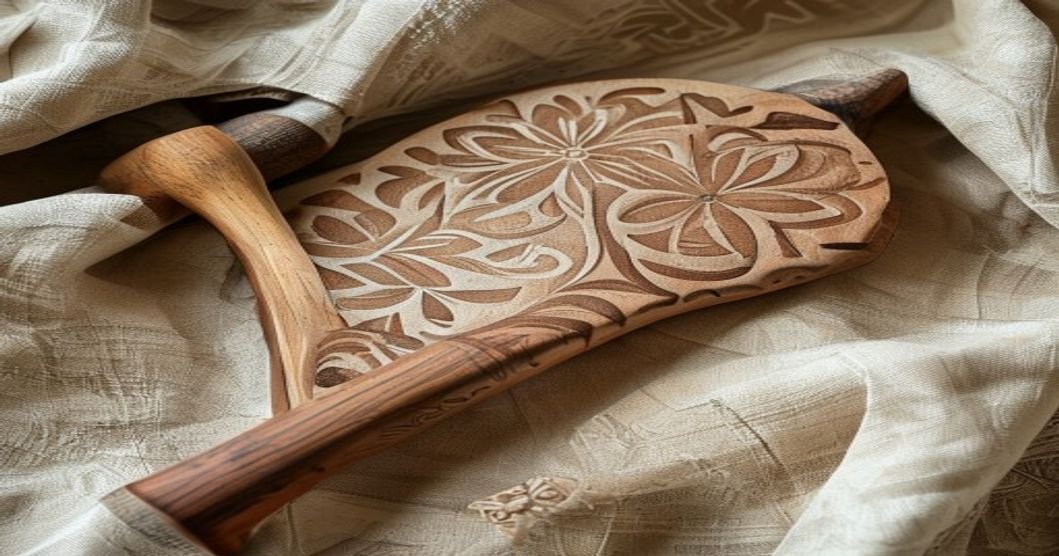
The block-printed wrapping on a Tea Story hamper is Kalkame’s category of work. The Dakmanda check — the traditional Garo textile pattern — carved into a wooden block in Jaipur by a specialist craftsperson, printed by hand onto the wrapping in Guwahati. Each print slightly different. The weight of the hand in the pressure of the ink.

This is not decoration. This is the record of attention — the same thing Kalkame made. The pattern says: someone looked at this closely enough to carve it. Someone held the block at the right angle. Someone decided this wrapping was worth Kalkame’s category of work rather than a printer’s efficient reproduction.

The AHF story card inside the hamper is also Kalkame’s work. It carries a Garo story — an abisa tale, or a Saljong story, or Bisi and Bijong — to a child who will receive the hamper’s gift. The card is small. The story is short. But it holds memory in a visible form, which is what Kalkame always made.

The best gifts are Kalkame gifts. Not the most expensive. The most attended to. The ones that say: someone considered what you would find when you opened this, and made sure there was something there worth finding.

There is.

The hills where this story lives are the same hills where our tea grows. Explore teas from West Garo Hills →