
Posted on Leave a comment

The Cotton That Went to Europe: Garo Producers, Global Markets, and Who Keeps the Value

Garo Cotton Global Trade Supply Chain — How Garo cotton producers in West Garo Hills entered global markets — and who kept the value. A story about supply chains, ethics, and what direct trade actually means.

Garo Cotton Global Trade Supply Chain: What You Need to Know

For further reading, see Garo Hills (Wikipedia).

Garo Cotton Global Trade — How Garo cotton producers were connected to European markets — and what this historical supply chain teaches about fair trade, ethics, and where value goes.

For further research, see the Garo people of Meghalaya.

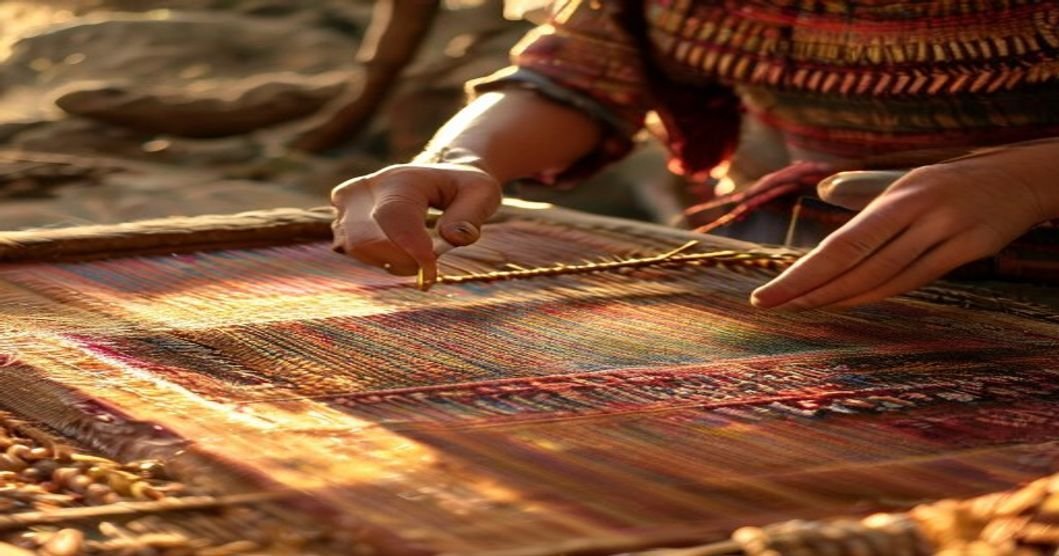
“Some who read this may be resting their feet the while on cotton grown in a Garo jhum,” wrote Rev. William Carey in 1919, noting that Garo hill cotton had found its way into European and Japanese felt and carpet mills.

The Garo farmers who grew that cotton received, at the frontier markets, trade goods: cloth, metal items, and liquor. The Bengali merchants who brokered it upward received a margin. The British trading companies that shipped it received a margin. The mills that processed it received the largest margin of all. The carpet buyer in London who rested their feet on Garo cotton had no idea where it came from, paid a fair market price for a finished product, and completed a supply chain that began with a woman sowing cotton seed in the jhum clearing of a hill she would farm for two years and then abandon.

The structure of value extraction in global commodity supply chains has not materially changed since the frontier markets of the 18th century. The person at the beginning of the chain — the one whose labour and land and knowledge produces the raw material — typically receives the smallest portion of the final sale price. The people who add the least non-replicable value (transportation, branding, retail presence) receive the largest portion.

Tea is not exempt from this. The global tea industry is built on this exact structure. Gardens in Assam, Meghalaya, and Darjeeling supply raw leaf that is auctioned, blended, branded, packaged, and sold at multiples of the garden gate price.

The Tea Story is a direct model: garden-to-consumer, without the auction house, without the broker, without the blend that dilutes the specific with the generic. The value that would ordinarily be distributed across the chain stays at both ends — the garden that produced it and the customer who drinks it. The Garo cotton farmer who walked five days to the frontier market and received cloth in exchange for fibre worth a fortune in London would recognise this problem. And they would recognise the alternative too.

Posted on Leave a comment

How to Drink Tea Like a Garo Elder: A Guide to Full Presence in Twelve Minutes

How To Drink Tea Garo Elder — A practical guide to the Garo elder's approach to tea — slow, present, deliberate. Twelve minutes and a different relationship to time.

How To Drink Tea Garo Elder: What You Need to Know

For further research, see the Garo people of Meghalaya.

The Garo elder in the hills above Tura in 1898 had a particular quality that the traveller who wrote about him could not quite name. He had seen hardship — fever, jungle, the grinding difficulty of the jhum cycle. He had walked five days to market and five days back. He had lived with elephants in the near distance and leopards on the path. He was not naive about difficulty.

And yet he was unhurried. The traveller noted this repeatedly, with something approaching envy. The Garo moved through their days at a pace that was efficient without being rushed — the work was hard, but the relationship to the work was not frantic. At the end of the day, they sat on the platform of the borang or the veranda of the changy and were still. The chu came out. The stars appeared. The hills went dark.

This is not achievable in full in modern life, and we should not pretend otherwise. But it is partially achievable, in small windows, if you design them deliberately. The twelve-minute cup of tea is one such window.

How to do it:

Heat water to the right temperature — 80°C for green tea, full boil for black. This takes about three minutes. Use them to put the phone face-down. Not silent — face-down. There is a difference.

Measure the tea properly. Whole-leaf tea from the West Garo Hills needs one teaspoon per cup, no more. This is not a ceremony. It is precision, which is a different thing.

Steep for the right time. Three minutes for green. Four for black. Set an actual timer and do not guess. While it steeps, do not reach for the phone. Look at something that is not a screen. The window. Your hands. The steam from the cup.

Drink it before it’s cold, which is to say: drink it now. Not in a minute. Not after checking one more thing. The Garo elder on the changy veranda did not defer the end of the day. He was on the veranda because the day was ending and that was where you were when the day ended.

You have twelve minutes. The squirrel is chewing the strings, but they have been holding since before you were born. The buffaloes are still running across the sky. The four strings are still intact. The tea is ready.

Drink it like someone who knows where they are.

The hills where this story lives are the same hills where our tea grows. Explore teas from West Garo Hills →

Posted on Leave a comment

The Borang: Why the Garo Built Their Beds in Trees (And What It Says About Rest)

Garo Borang Tree House Rest — The Garo borang — a tree platform for sleeping and watching — was designed for rest and perspective simultaneously. What this architectural choice teaches about recovery.

Garo Borang Tree House Rest: What You Need to Know

For further research, see the Garo people of Meghalaya.

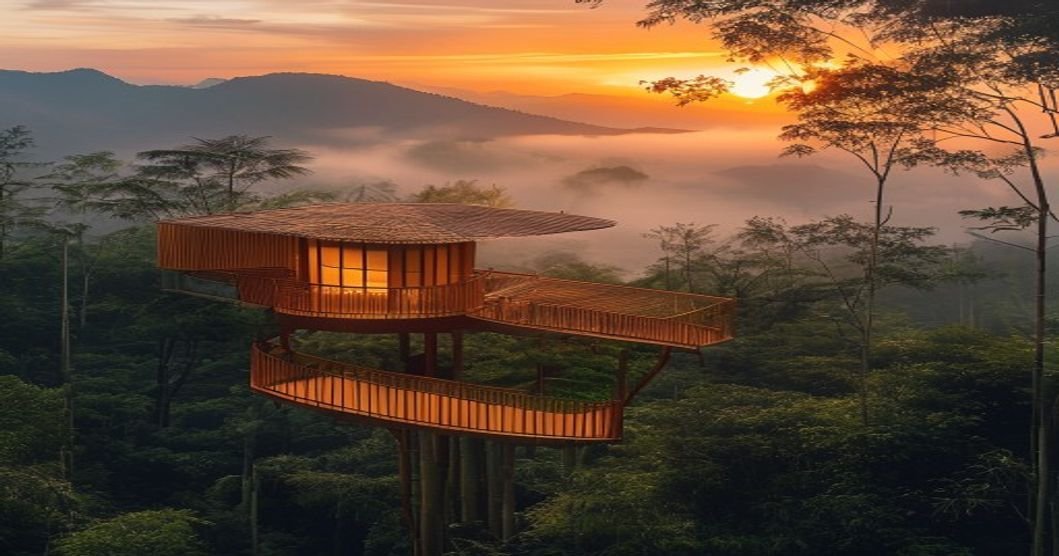
In the Garo hills, a traveller passing through the jungle would sometimes look up and see a house in a tree. Not a children’s platform — a real house. Forty feet off the ground, lashed to the branches with creeper ropes, floored with bamboo, inhabited by an entire family who cooked, ate, and slept up there.

The Garo borang (tree house) was practical: it gave purer air than the jungle floor, protection from mosquitoes, and a vantage point over the jhum fields to watch for birds and animals eating the crops. A mother who needed to descend had to navigate a bamboo ladder with her baby on her back, the rungs a wide stride apart.

But a missionary traveller who passed through in 1898 noted something beyond the practicality. He wrote that the Garos “seem to love a high roosting-place and have a bird’s fondness for being cradled by the wind.” The borang wasn’t just architecture. It was a preference.

Forty feet of elevation changes what you can see. From the ground, a forest is a wall. From the borang, it’s a canopy — you can see the ridgelines, the direction of weather, the clearing where the rice is growing, the river glinting a valley away. You are the same person with the same problems, but the problems are down there and you are up here, swaying slightly.

We have almost no equivalent in modern life. Our buildings keep us at ground level even when we’re twenty floors up, because the windows don’t open and the air conditioning is the same as the floor below. Our phones keep us at ground level because every notification is a pull back to the immediate, the reactive, the ground-floor urgency.

The borang mind is the one that steps slightly out of the ordinary stream — not to avoid the work, but to see it from above. To watch the crops rather than be in them. To feel the wind, which does not carry email.

A cup of tea in a quiet place is the closest most of us get to forty feet in a tree. Take it seriously.

Posted on Leave a comment

All Property Descends Through the Women: The Garo Matrilineal System and What We’re Still Arguing About

Garo Matrilineal Women Authority Property — The Garo matrilineal system — where property, land, and clan identity descend through women — and what it shows about gender, authority, and inheritance.

Garo Matrilineal Women Authority Property: What You Need to Know

For further research, see the Garo people of Meghalaya.

In the Garo social system, all property belonged to and descended through women. Not theoretically — actually. The youngest daughter was the heiress of the house. A man who married into a Garo family did so on the understanding that the land was not his. The clan was divided into “motherhoods,” each tracing its line through the female side. The nokma’s wife held as much authority in council debates as the nokma himself — “possibly a little more,” noted an early observer, with what reads as grudging admiration.

The Garo system was not matriarchal in the sense of women holding all social power. It was matrilineal in the sense that the economic basis of the family — the land, the house, the inheritance — moved through the female line. Men held political and ceremonial roles. Women held the property. The system worked because both were considered necessary.

We are, in 2024, still discussing whether women should hold equal positions in corporate governance, whether the gender pay gap reflects structural bias or individual choice, whether maternal leave policies disadvantage careers. These are not new questions. They are ancient questions that the Garo hills had a working answer to several centuries before the modern corporation existed.

The Garo answer was not utopian. No system is. But it was functional, durable, and organised around a simple principle: the person who sustains the home has the claim to the home. The person who is most likely to be there across generations holds the thing that persists across generations.

The Garo woman who gave away her bark-cloth blanket — just pulled it off the roof and handed it to a stranger, smiling — did so from a position of security. She owned the house. She owned the land. She could afford to be generous. Generosity is easier when you are not afraid of losing the thing you give from.

Posted on Leave a comment

The Milky Way Is Stampeding Buffaloes: The Garo Story We Need Right Now

Garo Milky Way Buffaloes Wonder — The Garo see the Milky Way as stampeding buffaloes — a cosmology of wonder and scale. What this way of seeing says about our relationship to the modern world.

Garo Milky Way Buffaloes Wonder: What You Need to Know

For further research, see the Garo people of Meghalaya.

In the Garo hills, there was a story about the Milky Way. A great spirit had died. The other spirits were holding a ceremony — the drums were beating, the wailing had begun. Buffaloes were being brought for sacrifice, many of them, moving in a great herd. And then the drums frightened them. All at once, the herd panicked, turned, and ran — straight off the edge of the earth and into the sky. Their hooves left a dusty track across the darkness.

That track is the Milky Way. It has never faded because the buffaloes are still running.

This is the kind of story that takes ten seconds to hear and stays with you for the rest of the evening. You look up at the sky and you see something different from what you saw before. The pale band of light is no longer just light — it’s a herd in motion, frightened by the sound of grief, running across infinity.

Wonder is not a luxury. It is a cognitive function. The part of the brain that registers surprise and awe — that pauses and reconfigures its model of the world — is the same part that generates creative insight, flexible thinking, and the capacity to see problems from new angles. People who regularly experience wonder are measurably more cognitively flexible than people who don’t.

The Garo elders were not trying to teach cognitive flexibility. They were telling their children a story about the sky. But the effect was the same: every child who grew up knowing that the Milky Way was buffaloes looked up with slightly wider eyes than a child who had been told it was a distant galaxy cluster. Both facts are true. One of them is also alive.

Your next conference call can wait four minutes. Go outside. Look up. The buffaloes are still running.