
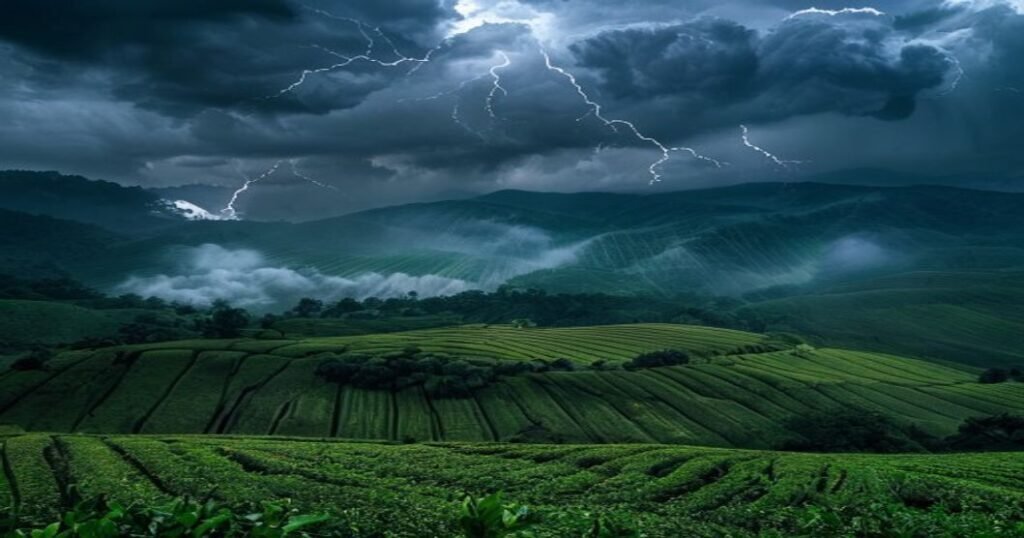
Achik Tale Nawang Wind Spirit — The story of Nawang — the Garo wind spirit who moves through the hills where our tea grows. An A'Chik tale about weather, nature, and the forces that shape everything.
For further research, see the Garo people of Meghalaya.
From A’Chik Golporang (Garo Folklore) Part III, Story 13 (Nawang), collected by Dhoronsing K. Sangma. Nawang is the A’chik spirit of the high wind.
In the cosmology of A’Chik Golporang Part III, Nawang is not a destructive force. The wind spirit is not the hurricane or the flood. Nawang is the high, steady wind that moves through the Garo Hills from the Bay of Bengal — the wind that carries moisture up the slopes, that pushes the monsoon clouds against the hills until they have no choice but to release.
Cherrapunji and Mawsynram — the world’s wettest places — sit in the same hill system as the West Garo Hills. The reason they receive 12,000 to 15,000mm of rain annually is Nawang. The wind picks up moisture over the Bay of Bengal, carries it north and east, and finds the wall of the Meghalaya hills. The hills stop the wind. The wind cannot go further. It gives everything it carried.
In the Garo understanding, Nawang was the mechanism of abundance — the carrier between the sea’s water and the hill’s soil. Without Nawang, no rain. Without rain, no rice, no cotton, no forest, no stream. Without the stream, no village by the stream. Without the village, no changy, no nokpante, no story.
Nawang, in the cosmological structure of Part III, works alongside Susime (the wealth-giver) and Saljong (the fertility deity). Nawang brings the water. Saljong brings the light. Susime brings the abundance that results when these two work together. No single element is sufficient. The system requires all three.
When you open a packet of tea from the West Garo Hills, the smell that comes out is partly Nawang. It is the smell of leaves that grew in 12,000mm of annual rainfall — leaves that were never dry, never stressed by shortage, leaves that had more water available than they could use and used it to produce exactly the complex, layered chemistry that makes this tea taste like this and nothing else.
Tea from rain-saturated land is different from tea grown under irrigation. The rain that falls from the sky carries chemistry from the atmosphere — minerals, organic compounds, the specific mix that this particular Nawang-driven rainfall delivers to this particular hill. Irrigation water is neutral. Nawang’s water is not.
The Garo hills morning begins in the dark, before sunrise, when the mist from the previous night’s rain is still sitting in the valley below the borang. In that hour, between Nawang’s night work and the morning, the leaves are at their most saturated, most alive, most ready. The plucking that happens in that hour carries Nawang’s work in every leaf.
The rain that fills your cup began over the Bay of Bengal. Nawang carried it. The hills received it. You are drinking a transaction between the sea and the sky.
The hills where this story lives are the same hills where our tea grows. Explore teas from West Garo Hills →
This story draws on A'Chik Golporang (Garo Folklore), compiled by Dhoronsing K. Sangma, published by Tura Book Room, Tura, Garo Hills, Meghalaya. This is an original English narrative — not a translation — using authentic Garo characters and situations as its creative foundation. We gratefully acknowledge the A'chik storytelling tradition.
Tea Story tea is grown in the West Garo Hills — where these stories live. Single-garden, no middlemen, re-brews three times. Explore our teas →