
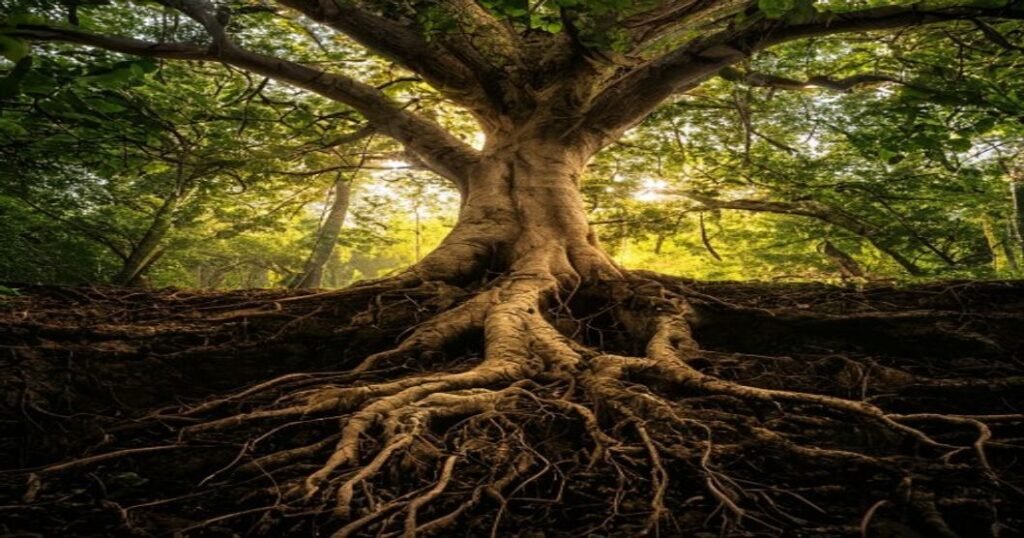
Achik Tale Sal Jajong Rooted — A Garo A'Chik story about the Sal tree and the Jajong — on rootedness, flexibility, and why being grounded does not mean being still.
For further research, see the Garo people of Meghalaya.
From A’Chik Golporang (Garo Folklore) Parts II and III, collected by Dhoronsing K. Sangma. The story of Sal aro Jajong appears twice in the collection — once in Part II and once in Part III — which in the A’chik tradition signals a story of central importance.
There is a story in the Garo hills that is told twice. When a story is told twice in the same collection — once in the middle book and once in the final book — the storytellers are marking it as something that cannot be said only once.
The story is about the sal tree (Shorea robusta) and the jajong, a smaller plant that grows along the stream banks of the Garo hills. In the story, the jajong admires the sal’s height — the way it can see far, the way birds rest in it, the way its canopy changes the light for everything beneath.
“How did you get so tall?” the jajong asked.
“I did not try to be tall,” the sal said. “I went down. I went as far into the ground as I now go into the sky. Every year of height is a year of depth first.”
The jajong thought about this. “But you cannot move. You are in one place always.”
“Yes,” the sal said. “That is what it costs.”
In the Garo hills, the sal tree was not merely a tree. It was a marker of history — sal forests were old forests, forests where the land had never been cleared, where the rootstock went back generations. To sit under a sal was to sit under something that knew the hill from the inside. The sal could tell you the water table. The sal could tell you the history of the rains. The sal’s wood had a specific quality — a density and an aromatic quality — that came entirely from which hill it grew on and how many years it had grown there.
This is what the Garo called quality. Not the quality of the object in isolation, but the quality of the place in the object.
The tea world uses the French word terroir for this — the taste of the place in the cup. But the Garo were describing it long before the French needed a word for it. The sal tree had terroir. The sal tree was terroir — it was so completely the product of its specific hill that you could not move it and have the same tree.
Single-origin tea works the same way. Tea grown in the West Garo Hills tastes like the West Garo Hills — the basalt soil, the 12,000mm annual rainfall, the specific altitude, the specific fog that moves through the valley between 4am and 7am each morning. Move the plant. Change the soil. Change the rain. You have tea. But you do not have this tea.
The story is told twice because it is worth knowing twice. The jajong moves. The sal stays. The sal can be seen from far away. This is what it costs — to be always in one place — and this is also what it gives.
Your cup holds a sal tree’s logic. It could only come from here.
The hills where this story lives are the same hills where our tea grows. Explore teas from West Garo Hills →
This story draws on A'Chik Golporang (Garo Folklore), compiled by Dhoronsing K. Sangma, published by Tura Book Room, Tura, Garo Hills, Meghalaya. This is an original English narrative — not a translation — using authentic Garo characters and situations as its creative foundation. We gratefully acknowledge the A'chik storytelling tradition.
Tea Story tea is grown in the West Garo Hills — where these stories live. Single-garden, no middlemen, re-brews three times. Explore our teas →