Posted on Leave a comment

What ‘Own Garden, Own Factory’ Actually Means for the Tea in Your Cup

The phrase “own garden, own factory” appears on our packaging for a specific reason: it is the single fact about our operation that explains everything else. The no-bitterness. The re-brewability. The consistency. The freshness. The traceability. All of it flows from this one structural reality — that we grow and process our tea in the same place, under the same management, with no separation between the two.

To understand why this matters, it helps to understand how most tea does not work this way.

How the Tea Industry Usually Operates

India has hundreds of tea gardens — estates of varying sizes that grow and perform initial processing (withering, rolling, oxidation, drying) on their harvest. Most of these gardens sell their processed tea at auction, where buyers — blending companies, brand owners, export houses — purchase lots from multiple sources.

A buyer might blend lots from six different gardens across Assam, add some Darjeeling for fragrance, and sell the result under a single brand with a photograph of one garden on the box. The photograph is not dishonest, exactly. But it does not represent what is actually in your cup.

When a brand buys from multiple gardens and blends for consistency, quality is averaged. The best lots elevate the blend. The weakest lots dilute it. The result is always somewhere in the middle.

What Owning Both Changes

When the garden and the factory are the same operation — managed by the same people, accountable to the same standards — quality control operates at every single stage rather than beginning only when the tea arrives at a processing facility.

Plucking decisions are made based on exact leaf condition that day, not on a production schedule agreed with an outside buyer. Processing parameters — wither duration, oxidation time, drying temperature — are adjusted for the specific batch of leaves coming in from our own fields that morning, not calibrated for an average lot from an unknown source. Packing happens in our facility immediately after processing is complete.

The people who grow the tea are the same people who process it. There is no handoff, no translation of quality standards between two separate entities with different incentives. This is a simple operational reality, but it has large consequences for what ends up in the packet.

Single Origin as Quality Guarantee

Our tea from West Garo Hills has a specific flavour profile that comes from this specific garden. The mineral character of our laterite soil, the influence of Meghalaya’s rainfall, the altitude and orientation of our plots — these are fixed variables that do not change between batches. When you find a green tea or black orthodox from us that you like, you can return to it with confidence, because we have not changed the source material.

Brand consistency in a blended product is achieved by adjusting the blend. Brand consistency in a single-origin product is achieved by managing the garden well. We prefer the latter, because it means we are getting better at growing tea rather than getting better at compensating for variable inputs.

What FSSAI 21719011000008 Covers

Our FSSAI registration number — 21719011000008 — is not simply a compliance certificate. It is a commitment to traceable, hygienic, accurately-labelled production. The number corresponds to a specific registered facility: our factory in West Garo Hills. If you want to verify what it covers, the FSSAI public database will tell you. This level of traceability is only possible because there is a single facility to register, a single garden to audit, and a single production chain to document.

Tea that passes through multiple hands cannot offer this kind of single-point accountability. We can, because we never pass the responsibility to anyone else.
Posted on Leave a comment

A Tea Garden in West Garo Hills: Our Story and Why Origin Matters

West Garo Hills Tea Garden Story — The story of our tea garden in West Garo Hills, Meghalaya — why origin matters, how we grow and process our teas, and what garden-to-cup means for the quality in your cup.

West Garo Hills Tea Garden Story: What You Need to Know

West Garo Hills Tea Garden Story: What You Need to Know

West Garo Hills Tea Garden: What You Need to Know

West Garo Hills Tea Garden: What You Need to Know

West Garo Hills Tea Garden: What You Need to Know

West Garo Hills Tea Garden: What You Need to Know

West Garo Hills Tea Garden Story: What You Need to Know

West Garo Hills Tea Garden: What You Need to Know

West Garo Hills Tea Garden Story: What You Need to Know

West Garo Hills Tea Garden Story: What You Need to Know

West Garo Hills Tea Garden Story: What You Need to Know

West Garo Hills Tea Garden — The story of our tea garden in West Garo Hills, Meghalaya — why we grow, process, and pack our own tea, and what single-origin means for your cup.

For further research, see West Garo Hills, Meghalaya.

West Garo Hills isn’t a region most people associate with tea. Meghalaya as a whole produces a small fraction of India’s tea compared to Assam or Darjeeling, and within Meghalaya, West Garo Hills — centred around Tura — is even less known for it. We think that’s part of what makes our tea worth trying.

One Garden, One Factory, No Middlemen

The vast majority of tea sold in India — even tea marketed as premium or single-origin — passes through a chain of growers, brokers, blenders, and packagers before reaching a shelf. Each step adds cost, time, and an opportunity for the leaf’s actual origin and freshness to get diluted or obscured.

We do it differently: every tea we sell is grown in our own garden in West Garo Hills and processed in our own factory. There’s no broker buying leaf from multiple smallholders and blending it together, and no third-party packaging facility handling our tea alongside dozens of other brands’ products.

Why This Is Harder, and Why We Do It Anyway

Running your own garden and factory is more operationally demanding than sourcing blended leaf from established tea auctions — it means we’re directly responsible for everything from soil health to processing consistency, with no supplier to fall back on if something goes wrong. We’ve chosen this model because it’s the only way to genuinely guarantee what’s in the packet: leaf from our hills, processed by us, with nothing added or substituted along the way.

The Terrain Itself

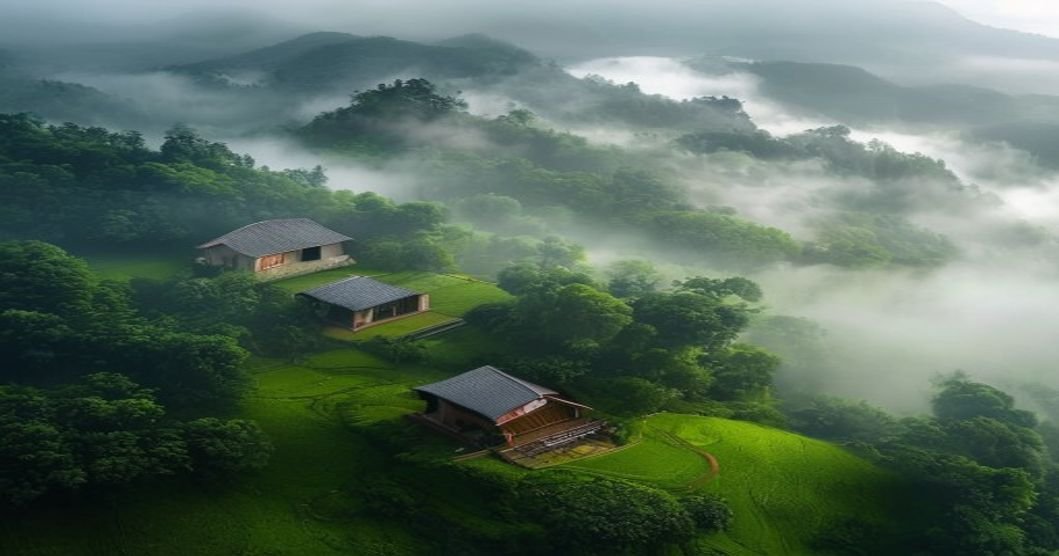
West Garo Hills sits in the western part of Meghalaya, characterised by hill terrain, high rainfall, and the misty, humid mornings typical of the broader Meghalaya region (the same general climate pattern that makes nearby areas among the wettest places on Earth). This terrain produces slower-growing tea bushes than flat lowland estates — which, as with high-altitude tea elsewhere in the world, tends to concentrate flavour rather than dilute it.

What This Means in Practice

Because we control the whole chain, we can make specific, verifiable claims about our tea that blended-leaf brands often can’t:

  • Every product is FSSAI registered (license 21719011000008) under our own manufacturing operation, not a third-party packer
  • Our whole-leaf orthodox and green teas can be genuinely re-brewed up to 3 times — a direct result of careful, unhurried processing rather than rushed mechanical handling
  • We know exactly which garden plot, which season, and which processing batch every packet comes from

Visit Our Range

Our full catalogue — Green Tea, Black Orthodox Tea, and CTC Milk Tea — comes from this single garden and factory. Browse the full collection or read about our re-brewing approach to understand how garden-to-cup control shows up in the actual tasting experience.