

Posted on Leave a comment

Goerani Milam: What the Garo Said About Dreams, and the Tea That Meets Them

Goerani Milam Garo Dreams Story — A Garo A'Chik folktale about Goerani Milam — the dream that arrives before the morning. What Garo wisdom says about dreams, thresholds, and beginning.

Achik Tale Goerani Milam: What You Need to Know

Goerani Milam Garo Dreams Story: What You Need to Know

Achik Tale Goerani Milam — A Garo A'Chik story about Goerani Milam — the dream — and the tea that meets it. On rest, imagination, and what the Garo understood about the unconscious mind.

For further research, see the Garo people of Meghalaya.

From A’Chik Golporang (Garo Folklore) Part II, Story 10 (Goerani Milam), collected by Dhoronsing K. Sangma. Milam means dream in A’chik.

In the Garo hills, the dream was not decoration. It was information.

The A’chik storytellers placed dreams — milam — at the centre of some of their most important stories. In Goerani Milam, a vision arrives in the space between sleeping and waking that contains something the waking world cannot carry on its own. It is not a fantasy or a wish. It is a message from the part of the self that can only speak when the rest of the self is quiet.

The Garo understanding was precise: certain things can only be known in the threshold state. The demon that has been causing your sickness reveals its name at the edge of sleep. The answer to the problem you have been circling for days comes in the moment just before waking. The person you need to visit appears in a dream that functions as a summons.

This was not mysticism. It was a practical system for accessing knowledge that the busy waking mind does not have time to surface. The dream state was a tool.

The threshold itself was considered sacred — the moment when the borang’s bamboo floor creaks as the first light comes through the gaps, when the birds begin before dawn, when you are neither in sleep nor fully in the day. In that minute, something is available that will be gone once the morning fire is lit and the children wake and the village begins.


Modern neuroscience agrees with the Garo on this, though it uses different words. The hypnagogic state — the border between sleep and waking — is when the default mode network is still active and the executive function hasn’t fully engaged. It is when free association is richest, when the brain connects things it cannot connect during focused work, when the answer that was inaccessible at 11pm is suddenly obvious at 6am.

The problem is we have organised the morning to destroy this state as quickly as possible. The phone alarm fires. The notifications begin. The world starts pulling at full volume before the threshold moment has had time to say its piece.

The Garo built in a space for the milam to speak. The fire was lit slowly. The first words of the day were quiet. There was no urgency until the urgency actually began.

A cup of tea — made before the phone is touched, drunk in the threshold space between the night and the day — is a small act of Garo intelligence. It says: the milam gets five minutes. Then the day begins.

Brew it slowly. The dream has something to tell you.

The hills where this story lives are the same hills where our tea grows. Explore teas from West Garo Hills →
Posted on Leave a comment

The Sal Tree and the Jajong: A Garo Story About Being Rooted

Achik Tale Sal Jajong Rooted — A Garo A'Chik story about the Sal tree and the Jajong — on rootedness, flexibility, and why being grounded does not mean being still.

Achik Tale Sal Jajong Rooted: What You Need to Know

For further research, see the Garo people of Meghalaya.

From A’Chik Golporang (Garo Folklore) Parts II and III, collected by Dhoronsing K. Sangma. The story of Sal aro Jajong appears twice in the collection — once in Part II and once in Part III — which in the A’chik tradition signals a story of central importance.

There is a story in the Garo hills that is told twice. When a story is told twice in the same collection — once in the middle book and once in the final book — the storytellers are marking it as something that cannot be said only once.

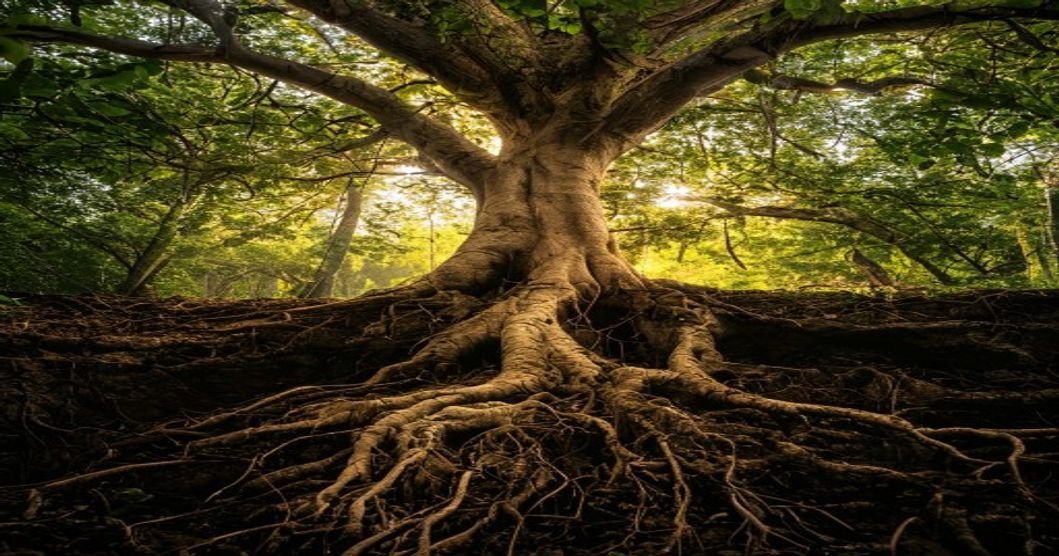
The story is about the sal tree (Shorea robusta) and the jajong, a smaller plant that grows along the stream banks of the Garo hills. In the story, the jajong admires the sal’s height — the way it can see far, the way birds rest in it, the way its canopy changes the light for everything beneath.

“How did you get so tall?” the jajong asked.

“I did not try to be tall,” the sal said. “I went down. I went as far into the ground as I now go into the sky. Every year of height is a year of depth first.”

The jajong thought about this. “But you cannot move. You are in one place always.”

“Yes,” the sal said. “That is what it costs.”

In the Garo hills, the sal tree was not merely a tree. It was a marker of history — sal forests were old forests, forests where the land had never been cleared, where the rootstock went back generations. To sit under a sal was to sit under something that knew the hill from the inside. The sal could tell you the water table. The sal could tell you the history of the rains. The sal’s wood had a specific quality — a density and an aromatic quality — that came entirely from which hill it grew on and how many years it had grown there.

This is what the Garo called quality. Not the quality of the object in isolation, but the quality of the place in the object.


The tea world uses the French word terroir for this — the taste of the place in the cup. But the Garo were describing it long before the French needed a word for it. The sal tree had terroir. The sal tree was terroir — it was so completely the product of its specific hill that you could not move it and have the same tree.

Single-origin tea works the same way. Tea grown in the West Garo Hills tastes like the West Garo Hills — the basalt soil, the 12,000mm annual rainfall, the specific altitude, the specific fog that moves through the valley between 4am and 7am each morning. Move the plant. Change the soil. Change the rain. You have tea. But you do not have this tea.

The story is told twice because it is worth knowing twice. The jajong moves. The sal stays. The sal can be seen from far away. This is what it costs — to be always in one place — and this is also what it gives.

Your cup holds a sal tree’s logic. It could only come from here.

The hills where this story lives are the same hills where our tea grows. Explore teas from West Garo Hills →