
Meghalaya Tea: Why West Garo Hills Grows Tea That No Other Region in India Can Replicate
Meghalaya tea has a geography problem — in the best possible sense. The state sits at the intersection of the Eastern Himalayas, the Bengal plains, and the Indo-Burma biodiversity hotspot. This is the same geography that made Northeast India the origin point of the world’s first cultivated tea, and it continues to produce conditions that no flat, hotter, more uniform climate can replicate.
Why Meghalaya Tea Is Different from Every Other Indian Tea
Draw a line around the seven states of Northeast India — Assam, Meghalaya, Manipur, Mizoram, Nagaland, Tripura, and Arunachal Pradesh — and you have enclosed one of the most biologically and geographically extraordinary pieces of land on the planet. This is where the Eastern Himalayas meet the Indo-Burmese tropical forests. Where the monsoon arrives first and stays longest. Where plant species unknown elsewhere grow in valleys that have never been systematically catalogued.
It is also where some of the finest tea in India is grown. Not coincidentally.
Meghalaya sits on the southern edge of this region, receiving the full force of the Bay of Bengal monsoon while being protected from more extreme continental influences by its plateau structure. The result is a climate that is warm and humid but not intolerably hot — wet enough to sustain continuous growth, but cool enough at altitude to slow the tea leaf and concentrate its flavour compounds. No single climate dominates here. Three climates overlap, and the Meghalaya tea that grows within that overlap is unlike anything grown where one climate prevails.
The Rainfall That Makes Meghalaya Tea Exceptional
Meghalaya receives between 11,000 and 12,000 millimetres of annual rainfall in its high-altitude zones — making it one of the wettest places on earth. Tea plants require consistent, high moisture during the growing season to develop the leaf density and chemical complexity that defines premium tea.
What matters equally is the seasonal distribution. The monsoon-dominant rainfall pattern creates distinct wet and dry periods. During the dry months, the tea plant undergoes physiological stress that concentrates polyphenols, catechins, and aromatic compounds in new growth. The first flush of Meghalaya tea after the dry-season dormancy consistently yields the highest EGCG concentrations of the year — a quality marker that distinguishes it from teas grown in more uniform climates.
Altitude, Slow Growth, and Polyphenol Concentration
Our garden in West Garo Hills sits at an altitude that produces cooler average temperatures than the lowland Assam plains. The Camellia sinensis plant grows more slowly at altitude. Slower growth means the developing leaf has longer to accumulate polyphenols.
West Garo Hills occupies a middle altitude — higher than the Assam plains, lower than Darjeeling — that produces a specific balance: enough elevation to slow the leaf and concentrate its compounds, enough warmth to produce full-bodied character. This is the sweet spot that makes Meghalaya tea distinct from both the bold, flat-grown teas of Assam and the more delicate, high-altitude teas of the Darjeeling hills.
Our Meghalaya Orthodox Tea is the clearest expression of this geography — single garden, single season, no blending, no auction.
Biodiversity and Natural Pest Management
The Indo-Burma biodiversity hotspot — one of the world’s thirty-six recognised biodiversity hotspots — covers most of Northeast India, including Meghalaya. This means the region has exceptionally high concentrations of endemic plant and animal species, many of which play roles in agricultural ecosystem health that are not fully understood but are unmistakably real.
Monoculture plantation tea — vast single-variety plantings — is structurally vulnerable to pest and disease pressure, requiring chemical intervention to survive. Meghalaya tea grown within intact biodiverse landscapes operates on a fundamentally different model. Predatory insects keep herbivorous insects in check. Bird species control caterpillar populations. The mycorrhizal fungi in the soil form symbiotic networks with plant roots that improve nutrient uptake and drought resistance.
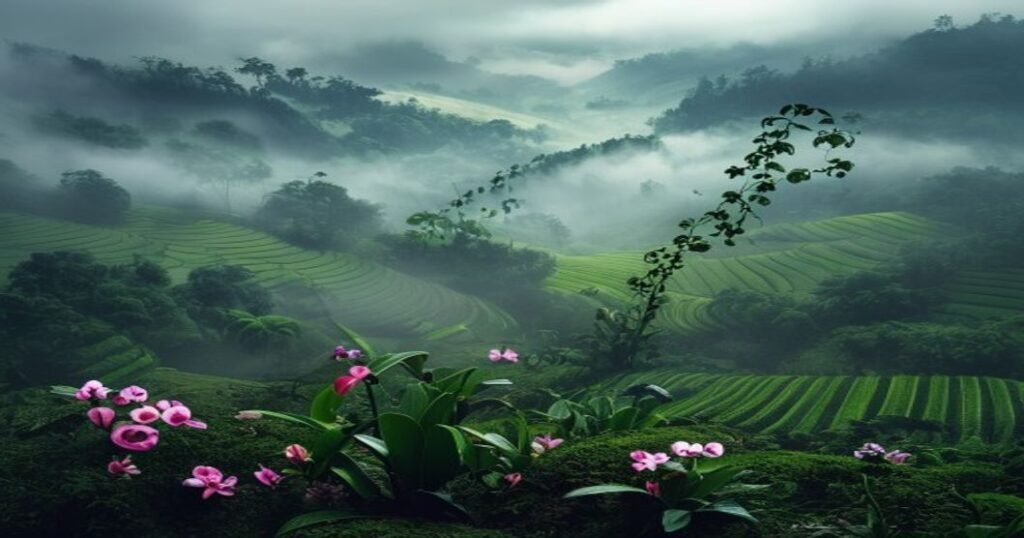
Our garden at West Garo Hills grows within this landscape. The forests surrounding it regulate humidity, provide windbreak, shelter the microbial communities in the soil, and create the specific microclimate in which our tea plants have grown and adapted over decades. None of this needs to be engineered. It is the baseline ecological condition of the landscape — the starting point, not the result of any particular farming intervention. This is why our Meghalaya tea requires no synthetic pesticide intervention.
Why Garo Hills Specifically
The Garo Hills are home to the Garo people, one of Meghalaya’s indigenous communities, who have managed this landscape with traditional practices for centuries. The Nokrek Biosphere Reserve, recognised by UNESCO, lies within West Garo Hills district — an acknowledgement of the exceptional ecological significance of this specific terrain.
You cannot move this garden to Tamil Nadu, Kerala, or even Assam and grow the same tea. The convergence of geology, rainfall, biodiversity, and traditional land stewardship that makes West Garo Hills exceptional is not portable. It is the place itself — and the Meghalaya tea grown here is the most direct and practical way to taste what that place has produced.
Frequently Asked Questions About Meghalaya Tea
Why is Meghalaya tea different from Assam tea?
Assam tea is predominantly CTC-grade, grown on flat plains producing bold but uniform flavour. Meghalaya tea grows at higher altitude with greater seasonal rainfall variation, producing whole-leaf orthodox tea with higher polyphenol complexity, more nuanced flavour, and higher EGCG concentration.
Is Meghalaya tea organic?
Not all of it. The Tea Story’s garden in West Garo Hills grows without synthetic pesticides due to the natural biodiversity of the surrounding landscape and FSSAI certification — but this is a garden-specific claim, not a blanket statement about all Meghalaya tea.
What makes West Garo Hills Meghalaya tea special?
High-altitude slow growth concentrates polyphenols. Monsoon rainfall with a distinct dry season produces high-EGCG first-flush teas. The surrounding Indo-Burma biodiversity hotspot forest eliminates the need for pesticide intervention and creates a soil microbiome fed by decades of native leaf litter.
Where can I buy Meghalaya tea?
Our single-garden Meghalaya Orthodox Tea is available directly from The Tea Story — single garden, single season, traceable to the West Garo Hills plot where it was grown and processed.