
When The Rain Comes — When the Rain Comes, You Make Tea: The Monsoon Ritual of Meghalaya — is one of the topics we explore on The Tea Story blog, drawing on our direct experience growing, processing, and tasting tea from our own garden in West Garo Hills, Meghalaya.
Let us be precise about what Meghalaya rain is, because the word “rain” is doing a lot of work here and could lead someone who has only experienced Delhi’s monsoon or Chennai’s northeast monsoon to underestimate the phenomenon significantly.
Cherrapunji, in the East Khasi Hills, holds the record for the highest annual rainfall ever measured anywhere on earth: 26,461 millimetres in a single year, recorded in 1860. The town has held the record for highest monthly rainfall, highest annual rainfall, and highest average annual rainfall at various points in its recorded history. Mawsynram, nearby, is its consistent rival. These are not anomalies in the Meghalayan landscape. They are the most extreme expression of a regional pattern.
West Garo Hills receives rather less than this — between 2,500 and 4,000 millimetres annually, which is still several times the national average. But the character of the rain is the same: consistent, heavy, and present from May to October in a way that changes the fundamental experience of being outside.
Rain as Condition, Not Event
In most of India, rain is an event. The monsoon arrives, the city pauses, the streets flood, the sky clears, life resumes. In Meghalaya, rain is less an event and more a condition. Life does not pause for it. Markets operate under tin roofs and with rivers running between the stalls. Football continues. Farming continues. School continues. The knups — the distinctive traditional bamboo and palm-leaf umbrellas worn by Khasi and Garo farmers, shaped like a wide dome that covers both the head and the load on the back — are practical tools, not nostalgic props. You need one.
What changes when it rains in Meghalaya is not the pace of activity. It is the quality of the interior. Because rain changes what it means to be inside. Under a roof with the rain hammering overhead, in a room that smells of damp earth and wet clothing drying on a line, the case for a cup of hot tea becomes not just reasonable but urgent.
Rain in Meghalaya does not cancel plans. It changes the texture of everything done while the plans continue. Tea is the texture of being warm in a cold wet place.
The Specific Experience
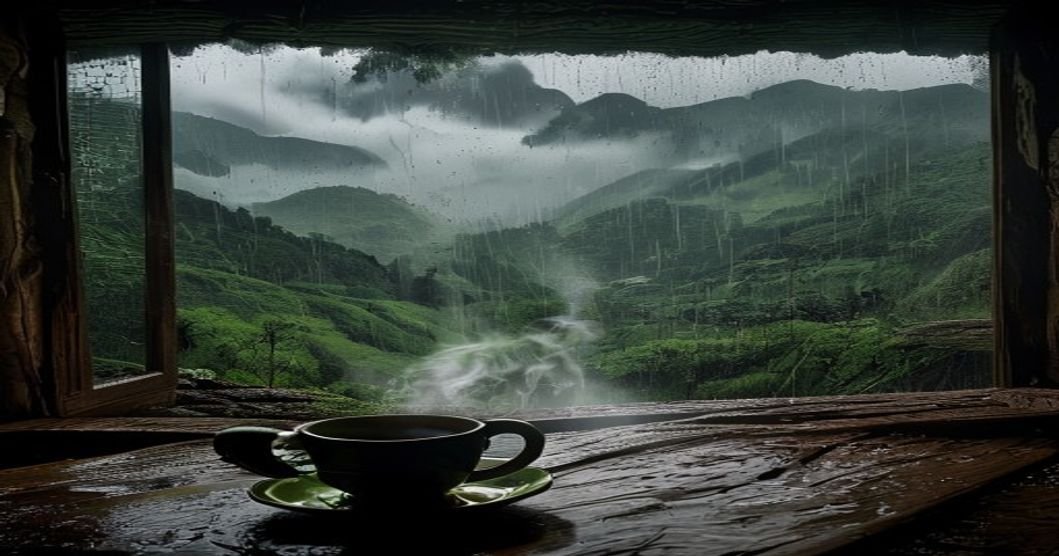
There is a particular quality to drinking tea during Meghalaya rain that is worth trying to describe. The cup is hot — genuinely hot, not politely warm — and the steam carries the smell of the tea into the air of the room. Outside the window, the rain has turned the hillside a specific shade of intensified green: the colour that vegetation takes on when it is thoroughly wet, which is somewhere between the green it is in dry sun and the green it becomes in photographs. The sound is constant and neutral in the way that white noise is neutral — present enough to fill silence without demanding attention.
Inside this condition, a cup of tea is not supplementary to the experience. It is central to it. You do not drink tea and then observe the rain. The rain and the tea are a single event, and separating them into components misses the point.
Where the Tea Comes From
The tea that West Garo Hills produces is grown in this same rain — the same monsoon, the same consistent downpour that turns the hillsides green and fills the rivers and makes tea drinking not merely pleasant but necessary. The rain that creates the experience of drinking tea in Meghalaya is the rain that created the tea being drunk. This is not a poetic statement. It is the literal water cycle of this specific place: cloud, rainfall, absorption, growth, harvest, cup.
When you drink our tea anywhere in India — in a dry city apartment, in an air-conditioned office, on a train platform where the sun is blinding — you are drinking something grown in that rain. Whether that connection is meaningful to you or not, it is there. And in Meghalaya, when the monsoon starts and someone hands you a cup without asking whether you want one, you are participating in the same ritual that has been happening on these hillsides for as long as people have lived on them.