
What Is Orthodox Tea — What Is Orthodox Tea? The Ancient Processing Method That Creates Complex Flavour — is one of the topics we explore on The Tea Story blog, drawing on our direct experience growing, processing, and tasting tea from our own garden in West Garo Hills, Meghalaya.
Walk into any tea shop or premium grocer and you will often see the word “orthodox” on labels for higher-end teas. It is used as a quality signal — which is accurate — but what it actually refers to is a specific set of manufacturing steps, each of which has a direct and traceable effect on what the finished tea tastes like.
Understanding orthodox processing is understanding how the best tea in the world is made.
The Orthodox Process, Step by Step
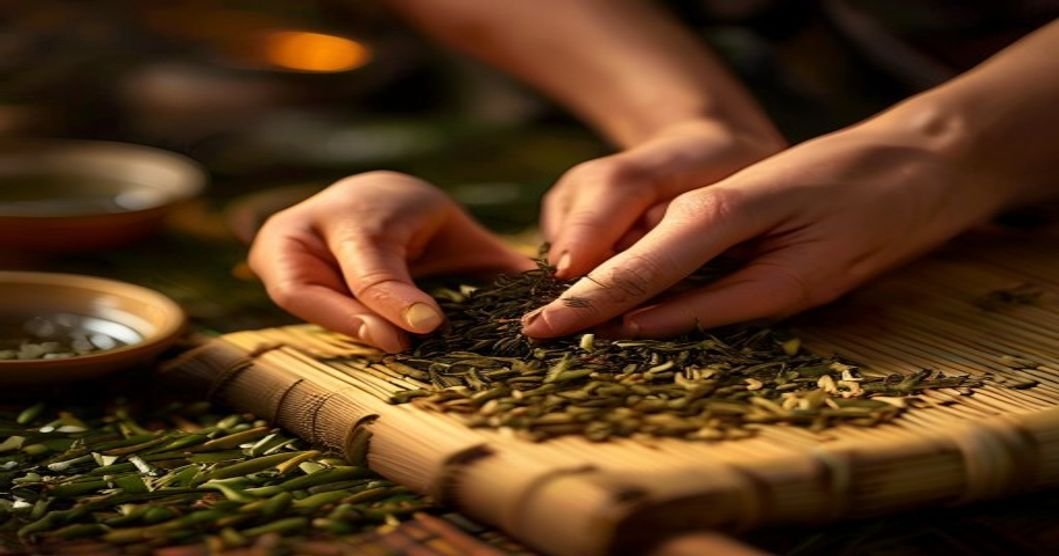
Withering. After plucking, fresh tea leaves are spread in thin layers on wire mesh beds or troughs and left for twelve to twenty hours. During this time, the leaf loses 60–70% of its moisture content and the cell walls begin to break down slightly. This is not drying — it is controlled softening, and it is the foundation for everything that follows. Withered leaves are pliable and have a characteristic grassy, slightly floral smell.
Rolling. Withered leaves are passed through a rolling machine — a flat table and a circular top plate that move in a specific pattern, pressing and twisting the leaves against each other. This breaks the remaining cell walls and expresses the leaf’s own enzymes and juices. The leaves emerge as twisted, tightly-coiled pieces that look quite unlike the flat leaf that went in. Rolling is where the tea’s character begins to be set.
Oxidation. Rolled tea is spread on cool, humid tables and left to oxidise. The enzymes released during rolling react with oxygen in the air. For black tea, this continues for two to four hours until the leaves turn a rich copper-brown and develop the complex aromatics that characterise a well-made cup. For oolong, the process is stopped partway through. For green tea, oxidation is prevented entirely by immediately applying heat after rolling.
CTC takes the same fresh leaf and turns it into uniform pellets in under five minutes using industrial machinery. Orthodox takes the same leaf on an eight-to-twelve-hour journey that preserves and develops its complexity. Both produce tea. The similarity ends there.
Firing. The oxidised leaf is passed through a drying machine at temperatures between 90 and 120 degrees Celsius, reducing the remaining moisture to 3–4%. This stops oxidation, stabilises the leaf, and creates the final roasted notes in the aroma. The result is the finished dry tea leaf — twisted, complex, whole.
Why the Process Creates Better Flavour
Orthodox processing works at the speed of chemistry rather than the speed of industrial production. Each step creates conditions for specific flavour compounds to develop: the withering builds amino acid concentration; the rolling creates the enzymatic reactions that produce aromatic compounds; the oxidation develops hundreds of volatile molecules responsible for the nuanced flavour of a good black tea.
CTC (Cut-Tear-Curl) machinery does in minutes what orthodox machinery does in hours: it shreds the leaf, breaks every cell simultaneously, and produces a uniform, fast-infusing pellet. CTC tea is strong and consistent — ideal for the masala chai market — but it does not have the layers of flavour that develop through slow, stepwise orthodox processing. You extract everything from a CTC leaf immediately. Orthodox tea holds back compounds for second and third steepings.
Our Orthodox Teas
Both our black teas and green teas from West Garo Hills use orthodox processing in our on-site factory. The factory is in the garden, which means there is no gap between plucking and withering — the leaf goes directly from the field to the wither beds within hours of being picked. This freshness at the start of the process is reflected in the quality at the end of it.
If you have only ever drunk CTC tea, the first time you brew a well-made orthodox black tea from a single garden will be a noticeable experience. The complexity, the re-brewability, and the absence of the sharp bitterness that CTC can produce — all of it comes from this process, applied to the right leaf, grown in the right soil.