
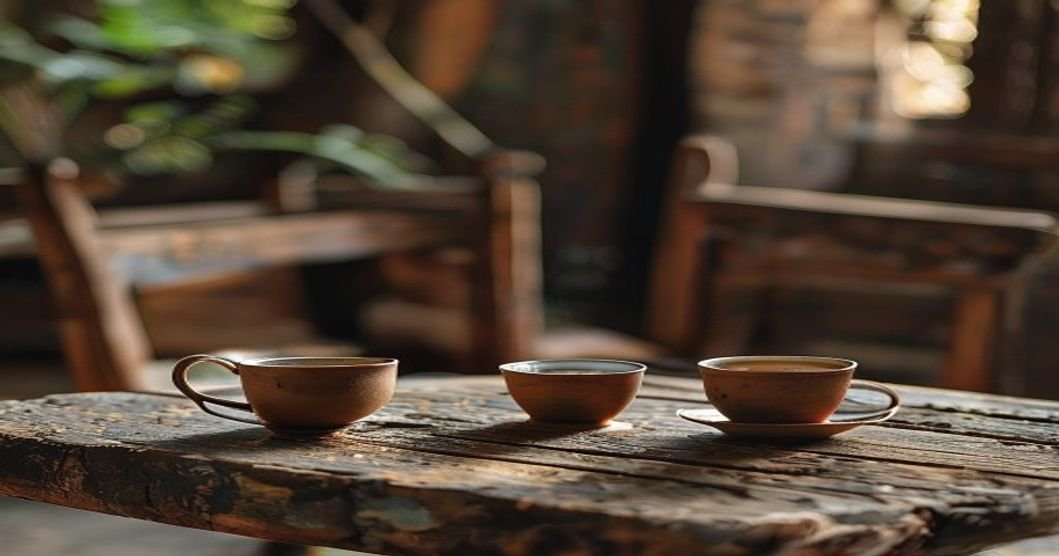
Tea As The Social — The Silence Between Conversations: Tea as the Social Language of Northeast India — is one of the topics we explore on The Tea Story blog, drawing on our direct experience growing, processing, and tasting tea from our own garden in West Garo Hills, Meghalaya.
There is a particular social grammar to tea in Northeast India that is difficult to explain to someone who has not experienced it, and immediately recognisable to anyone who has. The grammar works as follows: you arrive at someone’s home or at a dhaba or at a relative’s house in a town you are passing through, you sit down, and within a few minutes — without asking, without being asked, without any transactional negotiation of the kind that governs most service interactions — tea appears.
It simply appears. Someone went to make it. You did not need to want it. Its presence is not contingent on your desire. It is contingent on your having sat down.
Tea as a Statement About People
This is not unique to Meghalaya — variants of this hospitality tradition exist across the Northeast, across parts of Assam, Bengal, and Odisha, and in different forms across South Asia. But the Northeast has preserved it with particular intensity, partly because the culture of hospitality in communities like the Garo, the Khasi, the Mizo, and the Naga has deep structural roots, and partly because the conditions of life in a hilly, often isolated landscape historically made mutual support not optional but necessary.
What you are doing when you offer tea without being asked is making a statement. You are saying: your presence here is expected and welcome. You are saying: I am not too busy or too inconvenienced to give you something. You are saying: the relationship between us is more important than whether you technically requested refreshment.
In a culture where tea is offered rather than ordered, the act of pouring says what conversation sometimes cannot.
The Dhaba at the Mountain Road
Picture a specific kind of place that exists all across the Northeast: the roadside dhaba at a mountain pass or a river crossing or at the edge of a small town. A few plastic chairs. A counter behind which an enormous aluminium vessel sits on a fire. The walls decorated with nothing particular. Rain on the roof.
At this dhaba, if you sit down for a minute, tea arrives. If you are there for half an hour and the owner has noticed your cup is empty, it is refilled. If you are visibly cold or wet — which you probably are, in Meghalaya — the refill happens faster. The tea is strong and sweet and the cup is small and the transaction, when it happens, is so low-key that it barely registers as a transaction at all.
This is not inefficiency. It is a specific social technology: a mechanism for making a stranger feel less strange, a traveller less alone, a guest less like an imposition. It costs very little and produces a disproportionate amount of warmth, which is the basic economics of good hospitality everywhere.
What This Has to Do with How We Make Tea
Our garden in West Garo Hills and the direct-to-consumer model through which we sell tea exist within this context. We are not a brand inventing a heritage. We are a garden in a district where tea has been offered to guests for generations — where the social meaning of the cup is woven into the fabric of how the community operates.
When we think about who will eventually drink our tea — sitting at a desk in Bangalore, in a kitchen in Delhi, on a balcony in Mumbai with the evening coming down — we think of the dhaba at the mountain road. We think of the cup that arrives without being asked. We think of what tea in the Northeast actually means, and we hope that something of that meaning travels with the leaf from West Garo Hills to wherever you open the packet.