
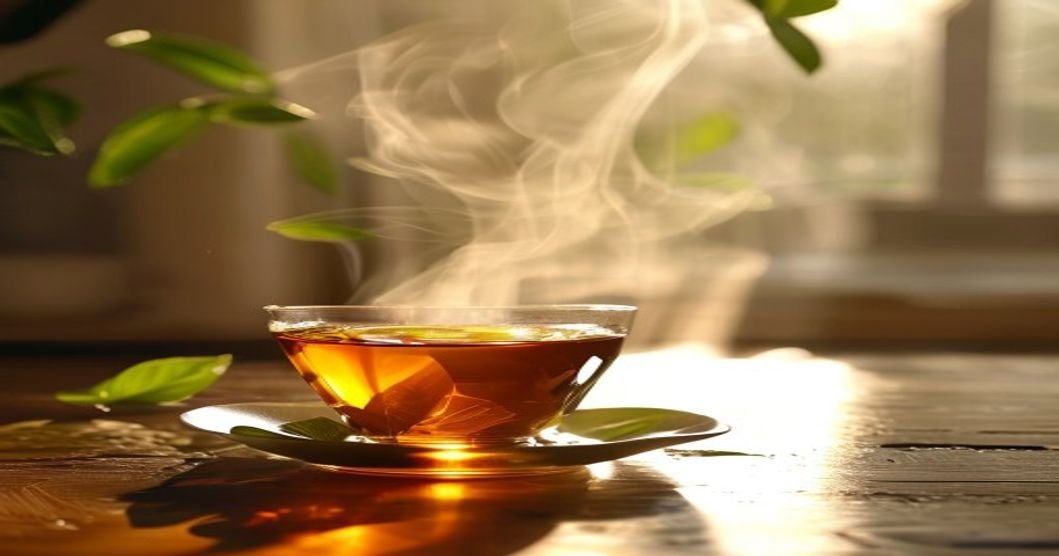
There is a straightforward test for the quality of any tea you buy: brew it, drink the first cup, pour hot water over the same leaves again, and taste the result. If the second cup is close in quality to the first — perhaps lighter in colour but not harsher, not flat, not empty — you have good tea. If the second cup is either completely spent or inexplicably more bitter than the first, you have found the limits of what you bought.
This test, which we call the re-brew test, reveals more about tea quality than the packaging ever will.
Why Tea Can Be Re-Brewed at All
Tea leaves, like all biological material, have a structure. The flavour compounds inside a tea leaf — L-theanine, catechins, aromatic esters, the complex volatile molecules that give each variety its characteristic scent — are distributed throughout the cell walls and cell contents of the leaf. Hot water is the solvent that extracts them.
In a whole leaf, the surface area exposed to water is relatively small compared to the total volume of material. The first steep extracts the most accessible compounds: surface aromatics, some L-theanine, a portion of the catechins. The interior of the leaf still holds a significant reserve. This is the second steep. Often it is the third as well.
In a tea bag filled with fannings and dust, there is essentially no interior. The particles are so small that every cell is either surface-exposed or one cell wall away from it. The first steep extracts nearly everything available. There is little left for a second pour, and what remains is disproportionately tannin — the compound that is most tightly bound to the leaf structure and that creates bitterness.
A second steep that tastes like a weaker version of the first is the sign of good tea. A second steep that tastes bitter or of nothing is the sign of a leaf that had nowhere to hide its quality in the first place.
What Each Steep Tastes Like
With our whole-leaf teas from West Garo Hills, the three steeps behave like three distinct but related experiences. The first is the fullest — the deepest colour, the most pronounced flavour profile, the full aromatic impact of a freshly-opened leaf. It is the tea at its most assertive.
The second steep, brewed with slightly hotter water or for thirty seconds longer, is typically smoother. The surface tannins have been washed out in the first pour, and the compounds that remain are more mellow. The L-theanine that was in the leaf’s interior comes through more cleanly. Many people find the second steep actually preferable to the first — softer, with a more complex background note.
The third steep is lighter still — a delicate, almost sweet version of the tea, with very little bitterness even if brewed longer than recommended. This is not thin or disappointing. It is what a leaf with good chemistry tastes like when most of its intensity has already been given to the previous cups.
The Simple Method
No special equipment is required. After your first cup, leave the used leaves in your pot or infuser. When you want a second cup, reheat the water to just below boiling (for green tea) or full boil (for black), pour over the same leaves, and steep for twenty to thirty seconds longer than your first brew. For green tea: first steep at 80°C for two minutes, second steep at 85°C for two and a half minutes. For black orthodox: both steeps at full boil, the second for three minutes instead of two.
The third steep follows the same logic: a little hotter, a little longer. The total time across all three steeps is fifteen minutes or less — which is why we describe our teas as re-brewable three times within fifteen minutes. It is not a marketing claim. It is the practical experience of anyone who uses the leaves properly.
The Value Calculation
Premium whole-leaf tea from a single garden costs more per gram than mass-market tea bag blends. This is the visible comparison that makes the price seem high. The less visible comparison: one serving of whole-leaf tea, re-brewed three times, produces three cups of good tea from the same material. The effective cost per cup is a third of the per-gram price. On that basis, the economics of quality tea are very different from how they appear at first glance.