
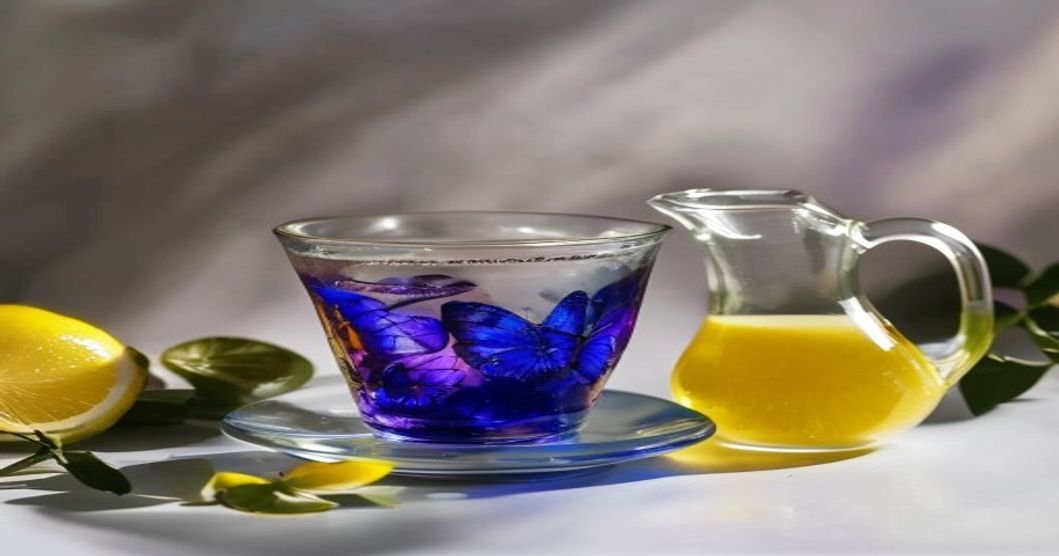
There is a moment when making butterfly pea flower tea that produces a reliable response in anyone watching it for the first time: the moment when you squeeze a few drops of lemon into the indigo-blue cup and watch it turn pink. Not faintly pink. Actively, clearly, unambiguously pink — almost magenta — in a few seconds, with no chemistry beyond the juice of a lemon and hot water.
This is not a gimmick. It is a natural pH indicator reaction of the same type that makes litmus paper change colour in chemistry class. The butterfly pea flower contains anthocyanin pigments — the same class of compounds that colour blueberries, red cabbage, and purple sweet potato — that are blue in neutral water and pink-red in acidic water. Lemon juice is acidic. The colour change is instantaneous and dramatic.
The Plant and Where It Grows
Clitoria ternatea — butterfly pea — is a climbing vine native to tropical Asia, widely distributed across South and Southeast Asia. It is not related to the tea plant (Camellia sinensis); it is a legume, a member of the pea family. The blue flowers are used fresh or dried to make a naturally caffeine-free herbal infusion. They grow prolifically in warm, humid climates and are cultivated across India, Thailand, and Indonesia for both their visual appeal and their traditional medicinal applications.
The flowers are intensely pigmented — a single dried flower releases enough colour to turn a cup of water bright blue. At scale, a small handful of dried flowers makes a visually striking batch that can be stored in the refrigerator for days and used as both a beverage and a culinary colourant for rice, desserts, and cocktails.
The colour change from blue to pink is a pH reaction. But the poetry of it — adding the sourness of lemon and watching something transform — is not a chemistry lesson. It is just a beautiful and surprising thing that happens in your kitchen.
Is It Actually Good for You?
Butterfly pea flower has been used in traditional Ayurvedic and Thai medicine for cognitive function, anxiety, and eye health. The anthocyanins it contains are well-studied for antioxidant effects. Research specifically on Clitoria ternatea extracts suggests potential nootropic (cognitive-enhancing) and anxiolytic effects in animal models, and the antioxidant capacity of the dried flower is measurably high.
The honest caveat is the same as for most herbal teas: the evidence from human clinical trials is limited, and drinking butterfly pea flower tea will not replicate the results of laboratory studies using concentrated extracts. What it will give you is a caffeine-free, visually extraordinary, mildly pleasant drink with a real antioxidant content and no identifiable negative effects.
How to Brew and Use
Three to five dried flowers per cup, water at full boil, steep for five minutes. The colour will be deep indigo-blue. Drink as is for the blue version. Add lemon, lime, or any acid for the pink. Combine with honey and ice for an iced version that impresses anyone watching. Mix with coconut milk for a blue latte that photographs beautifully.
Our Blue Tea blend uses dried butterfly pea flowers that we source for quality and colour consistency. The flowers are fragile and should be stored in a cool, dry place away from light; they will hold their colour for over a year in good storage conditions.