
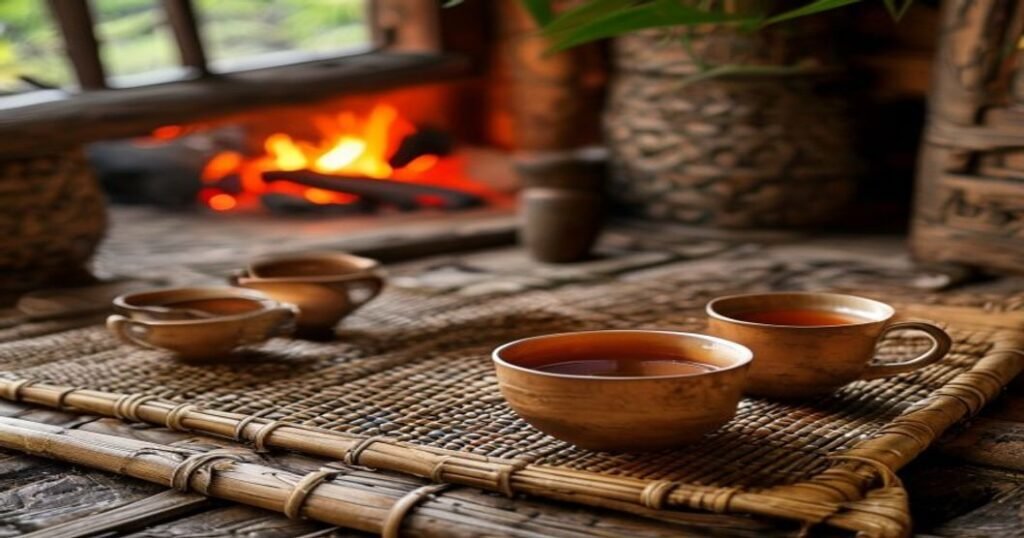
Tea And Garo Hospitality — How Tea Sits Quietly in the Garo Home: Hospitality, Tradition, and the Guest Who Is Never Turned Away — is one of the topics we explore on The Tea Story blog, drawing on our direct experience growing, processing, and tasting tea from our own garden in West Garo Hills, Meghalaya.
In Garo culture, refusing a guest is not merely impolite. It is a violation of something older and more fundamental than manners — a betrayal of the nokma’s responsibility, the headman’s duty, the basic architecture of a community that has organised itself around mutual care and reciprocal obligation for centuries. The Garo Hills of Meghalaya have been home to one of India’s most distinctive societies: matrilineal, forest-dependent, communal in ways that survive despite everything that has changed around them.
And in this culture, the guest is never turned away. The question is only what you put in front of them first.
The Nokma and the Logic of Giving
In traditional Garo society, the nokma — the headman of a village, a position typically held by the husband of the eldest daughter of the founding family — was responsible not only for governance but for hospitality. His household was, in a literal sense, the community’s host. Visitors, traders, travellers, people in need: all of them came to the nokma’s nokpante, the longhouse that served as the social centre of the village, and all of them were offered food and shelter.
This was not charity in the sense of an exceptional act. It was the baseline expectation of any Garo household with the means to offer something. A visitor sitting in your home unfed was a statement about the host’s character, not the guest’s entitlement. The obligation ran in one direction: if you have, you give.
Garo hospitality does not begin with asking the guest what they want. It begins with bringing them something — anything — before they have had time to feel like a burden.
What Was Offered
Traditionally, the Garo home offered rice, pork, bamboo shoot preparations, and chibai — a mildly fermented rice beer that has been made in Garo households for as long as anyone remembers. These were the foods of the forest and the field: practical, available, prepared always slightly more than was needed so that the unexpected guest could always be accommodated.
Tea arrived in the Garo Hills via a combination of routes: British administration from the west, trading connections from Assam to the north, the slow diffusion of a drink that had, by the early twentieth century, become the default hot beverage across most of India. It was adopted readily. Tea fits the Garo model of hospitality with remarkable ease: it is hot, it is quick to prepare, it is welcoming in a way that requires no elaborate cooking, and it fills a room with an aroma that signals to a guest that they are expected and welcome.
Tea as the Modern Form of an Ancient Duty
Walk into a home in West Garo Hills today. Whether you have been expected or not, whether the family knows you well or has met you only once, the first thing that happens — within minutes of sitting down — is that someone goes to the kitchen. Not to check whether it is convenient, not to ask if you want anything. Simply to make tea.
This is not a performance of hospitality. It is its continuation. The same impulse that sent chibai to the guest’s hand in the nokpante now sends a cup of tea across the threshold. The obligation has not changed. The vessel has.
Our garden in West Garo Hills grows tea in the soil of this culture. The people who work in the garden, who pluck and process the leaf, who live in the district — they drink this tea at home, they serve it to guests, they hold it in both hands during the evening rain. When we say the tea comes from West Garo Hills, we do not mean only the GPS coordinates. We mean the place, and the people, and the long tradition of offering something warm to whoever sits down at your table.