
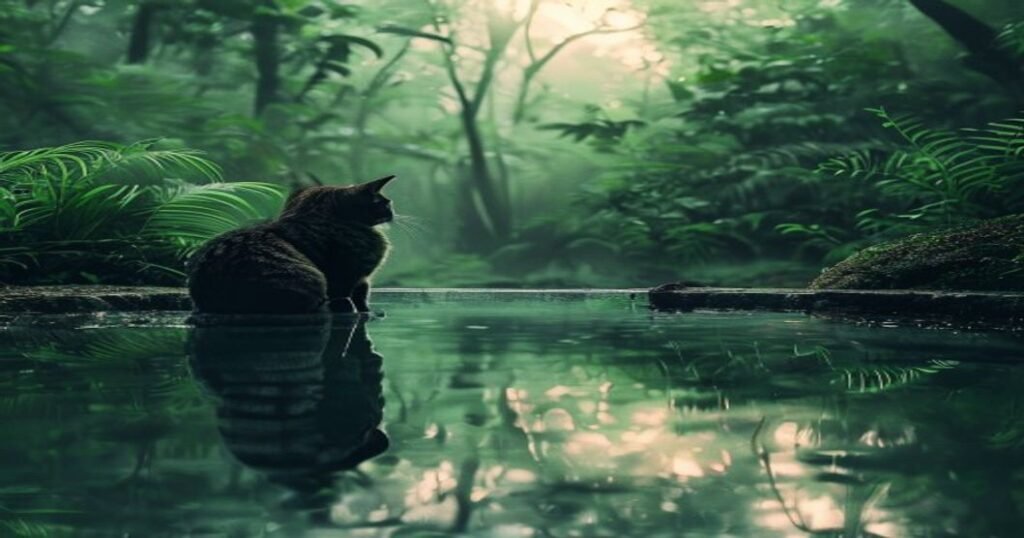
This is an Achik Tale Makkre Cat Mirror — a story from the A’Chik tradition of the Garo people of West Garo Hills, Meghalaya, the same hills where our tea grows. The A'Chik tale of Makkre the cat who fights his own reflection — a Garo folktale about ego and self-sabotage.
Garo hills understand about the battles we pick with ourselves.Achik Tale Makkre Cat Mirror — A Garo A'Chik folktale — Makkre the cat fights his own reflection. A sharp story about ego, self-sabotage, and the enemy we most consistently underestimate.
For further research, see the Garo people of Meghalaya.
From A’Chik Golporang (Garo Folklore) Part I, collected by Dhoronsing K. Sangma. This story is a new telling in English, drawing on the original A’chik tale.
Long ago in the Garo hills, there was a cat named Makkre who was known throughout the forest for being the finest, most capable cat in the valley. Makkre had never lost a fight, never missed a bird, never backed down from anything.
One morning, Makkre was exploring a house at the edge of the village when she found something she had never seen before. Propped against the wall was a flat, bright surface — a mirror that a trader had brought from the plains and left in the house.
Makkre looked at it. And there, looking back, was another cat. The same size. The same posture. The same bright, confident eyes.
Who are you? Makkre’s whole body said, arching.
The cat in the mirror arched back.
Makkre hissed. The other cat hissed at exactly the same moment. Makkre swiped. The other cat swiped. For hours — the whole long Meghalaya morning — Makkre fought this rival who matched her perfectly, who knew every move before she made it, who never tired, never retreated, never lost.
By afternoon, Makkre was exhausted. Panting. No blood, no victory, no defeat. Just the same cat still there, still watching.
A child from the village had been watching. She brought Makkre a small bowl of water and sat beside her. Makkre, too tired to be dignified, drank. When she looked up at the child, the child said nothing — just stroked her head.
Makkre looked back at the mirror. The other cat was doing the same thing. Being stroked. Resting. Looking just as tired.
The A’chik storytellers end this tale with a proverb: The enemy who matches you perfectly in every movement is worth examining closely.
There is a kind of morning that begins at the mirror. You look at what you’ve done, what someone else has done, what you haven’t done yet — and the fight starts before the day has actually begun. The comparison runs on a loop. Every scroll is another reflection. And the reflected cat is always exactly your level, always watching, always ready to respond.
The Garo cat fought her reflection for an entire day. The resolution wasn’t victory. It was a child with water, a moment of care, the decision to look away.
Brew your tea before you open the phone. Take ten minutes to be an animal resting by a bowl, not a cat fighting glass. The mirror will still be there. The rival will still match you perfectly. But you will have had your morning.
Our tea from the West Garo Hills is grown in the same hills where this story lives. It tastes best when you are not fighting anyone.
Ma’sichenggija gipinni kamko ja’rikpaania an’targna gimaanikosan ra’baa.
“The one who fights the image in the water is the one who never knows the forest’s actual work.” — A’Chik proverb
The hills where this story lives are the same hills where our tea grows. Explore teas from West Garo Hills →
This story draws on A'Chik Golporang (Garo Folklore), compiled by Dhoronsing K. Sangma, published by Tura Book Room, Tura, Garo Hills, Meghalaya. This is an original English narrative — not a translation — using authentic Garo characters and situations as its creative foundation. We gratefully acknowledge the A'chik storytelling tradition.
Tea Story tea is grown in the West Garo Hills — where these stories live. Single-garden, no middlemen, re-brews three times. Explore our teas →