
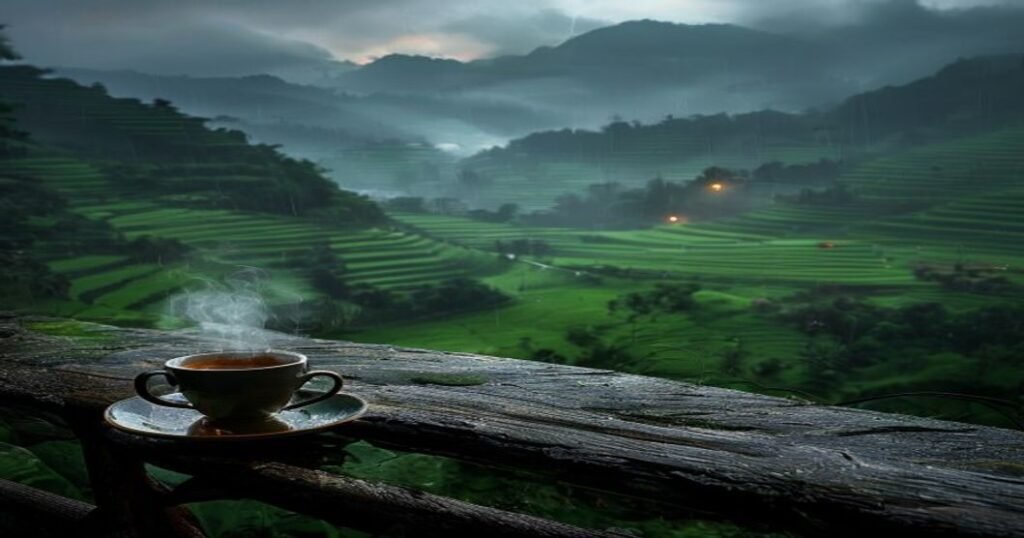
Football Rain And Tea — Football, Rain, and Tea: Why Meghalaya Is India’s Most Unexpected Tea Country — is one of the topics we explore on The Tea Story blog, drawing on our direct experience growing, processing, and tasting tea from our own garden in West Garo Hills, Meghalaya.
There is a particular kind of evening in Shillong that anyone from the Northeast who has lived away from home will tell you about. The rain comes in around five o’clock — not the polite drizzle of Delhi winters but a full, committed monsoon downpour, the kind that drums on corrugated iron roofs with the confidence of something that has been doing this for ten thousand years. Somewhere nearby, a football match is happening. It has been happening since the rain started. The players have no intention of stopping.
And somewhere close to the ground, under an awning or inside a roadside stall, a flask of tea is waiting. It is always waiting.
Football Is Meghalaya’s Religion
India is a cricket country, the received wisdom goes. Meghalaya did not receive this wisdom, or received it and politely declined. The state — and Shillong in particular — has been obsessed with football since the sport arrived with Scottish missionaries and British administrators in the late nineteenth century. The Shillong Premier League is one of the oldest football leagues in India. In a country that did not traditionally produce international footballers, an improbably large proportion of India’s national team players in the mid-twentieth century came from this small hill state.
The love is not casual. It is carved into the geography of the city: the Polo Ground, the Jawaharlal Nehru Stadium, the dozens of local maidans where games happen on weekends as a matter of civic ritual. Boys grow up playing football in the rain because the rain is simply the condition of existence in Meghalaya and waiting for it to stop is not a viable strategy for any outdoor activity.
Meghalaya gets between 2,500 and 12,000 millimetres of rain per year depending on location. Playing football through it is not stubbornness. It is pragmatic love of the game.
Where Tea Comes In
The connection between football and tea in Meghalaya is not a marketing association invented by a brand. It is practical and physical. Football in heavy rain produces a specific kind of cold — wet, penetrating, the kind that bypasses your jacket and settles somewhere in your chest. The solution to this cold has always been a cup of hot, strong tea, available at every roadside stall that sets up near any sporting ground in the Northeast.
Tea is the halftime drink. Tea is what you hold in both hands while watching from the terrace, rain jacket inadequate against the downpour, the match continuing below with complete indifference to the weather. Tea is what you drink after the final whistle, comparing the game, still slightly damp, standing under the awning until the rain decides to ease.
This is not a romantic association. It is a thermal and social reality. Tea at a football ground in Meghalaya is not a product placement. It is the logical answer to the question the rain keeps asking.
The Rain That Makes Both Possible
Meghalaya’s extraordinary rainfall — the same rainfall that makes the state the wettest place in India, that creates the cloud cover that moderates the temperature for tea cultivation, that leaches excess tannins from tea leaves and produces that characteristic natural sweetness — is also the rainfall that fills the Polo Ground with puddles, that has waterlogged every football pitch in Shillong at some point in the season, and that has trained three generations of Meghalayan footballers to play on wet ground as a matter of second nature.
The rain is the common denominator. It shapes both the football culture and the tea culture of this place. The same clouds that roll in off the Bay of Bengal and drop themselves on the plateau are the clouds that kept a midfielder running through mud at 4pm and sent him to the tea stall at 6pm for something hot to hold.
Our garden in West Garo Hills grows under this rain. The tea in your cup was grown in the same water that, a few hundred kilometres to the north, has been falling on football pitches since Shillong first learned the game. We find this connection appropriate. Tea country and football country are the same country, shaped by the same sky.