Cardamom And Tea — Cardamom and Tea: Why This Spice Has Been in Indian Chai for Four Hundred Years — is one of the topics we explore on The Tea Story blog, drawing on our direct experience growing, processing, and tasting tea from our own garden in West Garo Hills, Meghalaya.
The green cardamom pod — Elettaria cardamomum — is native to the moist forests of the Western Ghats in India, and has been in continuous cultivation there for at least two thousand years. It travelled early along the spice trade routes: it appears in ancient Greek texts, in Roman records, and in the earliest Arab spice markets. By the time the Mughal court in Delhi had established its full culinary ambition in the sixteenth and seventeenth centuries, cardamom was a fixture in both sweet and savoury preparations.
Its arrival in tea is probably no earlier than the eighteenth century, when tea itself was becoming more widely available in India. But the combination — green tea or black tea, milk, cardamom, and sometimes ginger, cinnamon, and black pepper — developed quickly into the masala chai template that has remained essentially stable for two hundred years.
What Cardamom Smells Like and Why It Works in Tea
Green cardamom’s aroma is dominated by 1,8-cineole (also present in eucalyptus and rosemary) and several terpene compounds, including alpha-terpinyl acetate and linalool. The combination produces something that is sweet, vaguely floral, slightly camphor-adjacent, and recognisable from across a room. It is one of the most complex single-spice aromatics in the kitchen.
In tea, cardamom does two things. It adds its own fragrance, obviously. But it also seems to lift and clarify the tea aroma in a way that neither element alone achieves — a synergistic effect where the cardamom’s volatiles interact with the tea’s own aromatic compounds to produce something more interesting than either in isolation. This is why chai brewed with cardamom smells better than plain tea and smells different from cardamom in water.
Cardamom in chai is not flavouring added to tea. It is a conversation between two aromatic systems, and the conversation is more interesting than either participant alone.
Green vs Black Cardamom
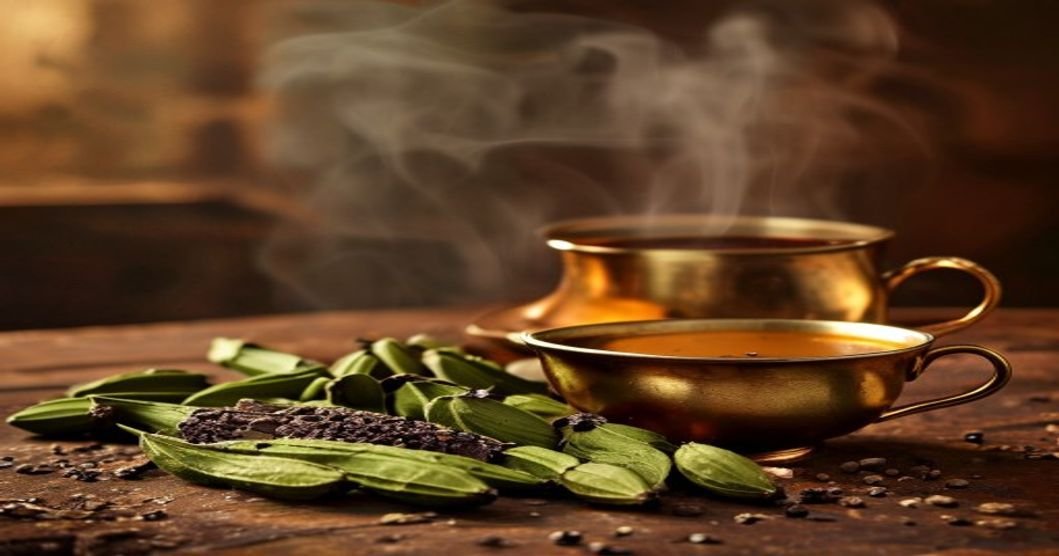
Green cardamom (Elettaria cardamomum) and black cardamom (Amomum subulatum) are different plants with different aromatic profiles. Black cardamom — larger, smoky, with a camphor intensity that green cardamom lacks — is used in savoury cooking, biryani and dal, but is rarely used in tea. In masala chai, always green cardamom. The subtle distinction matters if you are buying cardamom for a tea blend and find yourself looking at both options.
Our Cardamom Tea
Our Cardamom Tea from West Garo Hills uses green cardamom pods paired with our CTC tea base — the combination that produces a classic chai-adjacent cup with the cardamom’s sweetness complementing the robustness of the CTC without either overwhelming the other. It brews well with milk in the traditional preparation, but also works surprisingly well without milk for those who prefer a clear, spiced tea with a lighter body. The cardamom’s warmth makes it a particularly good cold-season tea.