
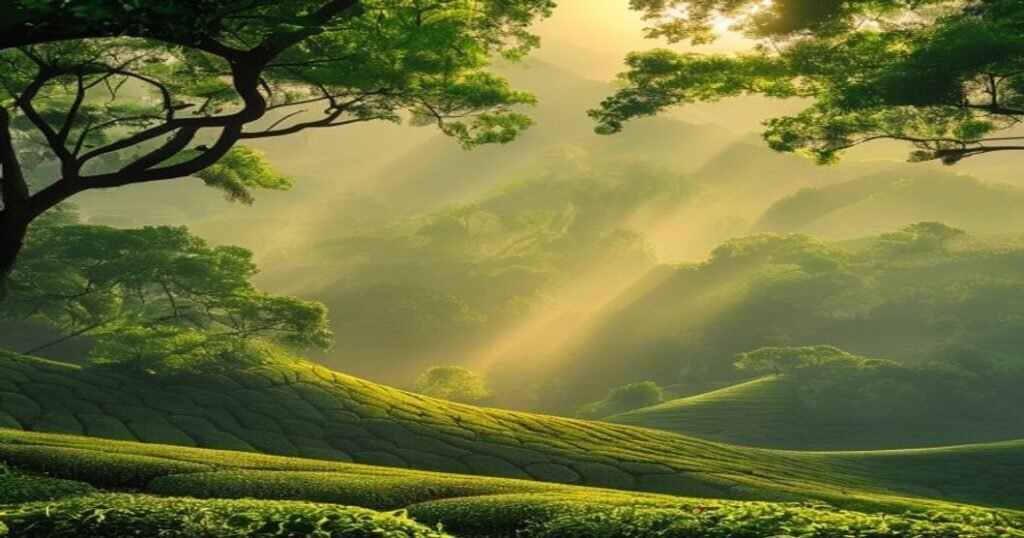
The Forest Came First — The Forest Came First: How the Garo Hills Became Tea Country — is one of the topics we explore on The Tea Story blog, drawing on our direct experience growing, processing, and tasting tea from our own garden in West Garo Hills, Meghalaya.
The Garo Hills are, at their core, a forest landscape. Not a landscape that used to have forest and now has other things, but a landscape where the forest is still structurally present, still governing the hydrology and the soil and the temperature and the wind, still the organising fact of the ecosystem. The tea garden in West Garo Hills where our tea grows exists within this forest structure, not as a replacement of it.
Understanding how tea came to grow here requires understanding the landscape that preceded it.
Jhum: The Agriculture of the Forest
The Garo people traditionally practised jhum cultivation — shifting agriculture, sometimes called slash-and-burn, which is a misleadingly destructive-sounding name for a system that is, when practised correctly and at appropriate density, genuinely sustainable and ecologically sophisticated.
In traditional jhum, a section of forest is cleared and burned, releasing the accumulated nutrients of the vegetation into the soil as ash. The cleared land is planted with mixed crops — rice, maize, vegetables, chillies — for one or two seasons. Then it is abandoned for ten to fifteen years, allowing the forest to regenerate. The cultivating family moves to a new section. Over decades, they rotate through a territory, always leaving more land in regeneration than under cultivation.
This system is not primitive. It is a form of landscape management that maintains biodiversity, prevents soil exhaustion, and works with the forest’s own regeneration capacity rather than against it. The forest does not disappear under traditional jhum. It shifts and recovers, carrying within it the accumulated fertility of centuries of organic matter decomposition.
The forest is not what the Garo people cleared to make their farms. The forest is the farm — rested, cycled, kept alive by the same movement that seems to disturb it.
When Permanent Crops Arrived
Colonial administration and later Indian government policy moved consistently toward sedentary, permanent agriculture and away from jhum — partly for practical administrative reasons (settled populations are easier to govern), partly from a genuine belief that permanent agriculture was more productive. Tea, as a perennial crop that requires permanent land allocation, fits the sedentary model exactly.
Tea cultivation arrived in the Garo Hills in the late colonial period and expanded gradually through the twentieth century. The soils that had been maintained by centuries of jhum rotation — deep, organically active, rich in the accumulated humus of alternating cultivation and forest recovery — turned out to be exceptionally suited to tea. The drainage characteristics of laterite hillside soil, the pH range, the mineral profile: all of it aligned with what Camellia sinensis thrives in.
What Remained
The transition from jhum to permanent cultivation was not total. Significant areas of the Garo Hills remain under forest cover, maintained by a combination of legal protection (the Balpakram National Park, the Nokrek Biosphere Reserve), community forest traditions, and the simple practical reality that the terrain is often too steep for any agriculture that involves motorised machinery.
Our garden sits in this landscape of mixed land use: tea gardens, forest patches, agricultural fields, villages, rivers. The forest around the garden is not decorative. It continues to regulate the humidity, protect the soil from erosion, shelter the predatory insects and birds that manage pest pressure without chemicals, and provide the ecological context within which the tea garden functions.
The forest came first. The tea grows now. The relationship between them is not conflict but continuity — the forest lending the garden what it needs to grow well, the garden repaying this debt by being exactly the kind of low-impact, permanent cultivation that the landscape can accommodate without losing what made it exceptional in the first place.